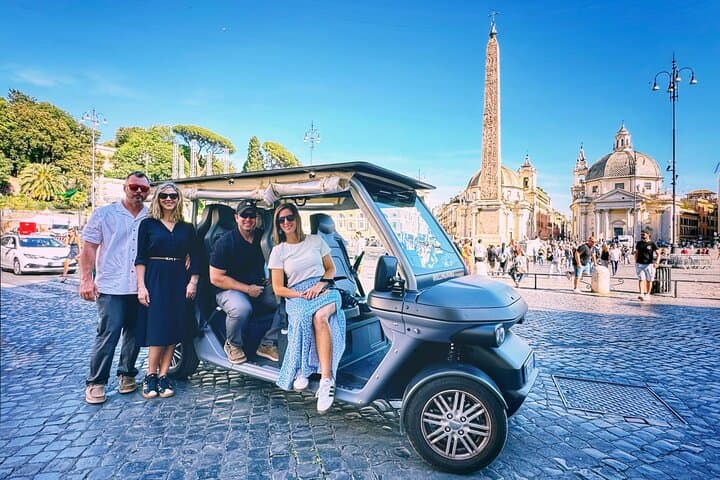
Private Golf Cart Tour in Rome
5,0 (5085)4h30Rome, Italy
From€189
This tour allows you to explore the Colosseum, Roman Forum, and Palatine Hill over a duration of three hours. The experience is designed for individuals interested in Ancient history and archaeology. It is suitable for those who can walk through historical sites and may not be ideal for people with mobility issues. Included in the tour is entry to all three sites, and a knowledgeable guide will provide insights into their historical significance. Be aware that this tour may entail walking over uneven surfaces. Ensure to wear comfortable shoes and be prepared for varying weather conditions.
Your reserved slot takes you straight to the security check and inside, onto the first and second tiers. From the walkway you look down into the hypogeum, the two-level basement of tunnels and lifts that pushed animals and gladiators up into the arena, and out across seating built to hold roughly 50,000 people in a stadium that could empty in minutes. Your guide covers how the games were staged, funded and eventually abandoned.
On the way out you pass beneath the largest triumphal arch left standing in Rome, 21 metres high and raised in AD 315 for Constantine's victory at the Milvian Bridge. Look closely at the sculpture: much of it was stripped from earlier monuments to Trajan, Hadrian and Marcus Aurelius, with the old emperors' faces recut into Constantine's.
At the top of the Via Sacra stands the arch Domitian raised to his brother Titus in AD 81. Inside the passage, one relief shows the spoils of Jerusalem carried in triumph through Rome — the seven-branched menorah taken from the Temple in AD 70, and one of the few surviving Roman images of it.
The last climb takes you up to where Augustus, Domitian and their successors built their palaces — the hill that gave every European language its word for "palace". You walk through the ruins of the Domus Augustana and along the sunken Stadium of Domitian, ending at the terrace above the Circus Maximus with the Forum, Piazza Venezia and the Colosseum laid out below.
You walk down the Via Sacra into the Forum itself, along the route triumphal processions took. Your guide picks out what the ruins were: the Curia where the Senate met, the eight surviving columns of the Temple of Saturn that held the treasury, the round temple where the Vestals kept the fire lit, and the spot where Caesar was cremated, still marked with flowers.
Reviews are hosted by Viator
This rating summarises the reviews collected by Viator, which keeps them on its own listing. We show the average exactly as it reaches us, without the individual comments.
Read the reviews on Viator