Berlin's Best: 2 Hour Walking Tour Third Reich and the Cold War
5,0 (6204)2hBerlin, Germany
From€20
Participants will explore Berlin's historical landmarks via rickshaw, visiting notable sites such as the Brandenburg Gate and the Berlin Wall. Tours are conducted in groups of up to 16 people, allowing for a comfortable experience while learning about the city's history. These tours are suitable for various occasions, including celebrations and events like bachelorette parties, and are designed for those interested in a unique way to see the city. Additionally, there are specialized tours focusing on street art, showcasing the artistic side of Berlin. It is important to note that these tours are eco-friendly and emphasize a combination of popular and lesser-known attractions.
The Brandenburg Gate made of sandstone is one of the largest and most beautiful creations of German classicism. It was built in the years 1788 to 1791 based on designs by Carl Gotthard Langhans the Elder, who was strongly oriented towards the propylaea of the Athens Acropolis. King Friedrich Wilhelm II had previously ordered the construction of the Brandenburg Gate because he was looking for a worthy architectural conclusion for the boulevard Unter den Linden.
History of the zoo At the end of the 17th century, Elector Friedrich III. create a "pleasure park for the population" from the former hunting ground. Over time, the park was redesigned according to several models, including Between 1833 and 1838 the famous landscape designer Peter Joseph Lenné transformed the zoo into an English public park. Sights in the Tiergarten But it is not just trees, shrubs and green spaces that determine the face of the approximately 200-hectare zoo. Many sights such as monuments and memorials, bridges, the Victory Column, the Federal President's Office, the House of World Cultures or the English Garden invite you to take a day stroll through the park. The English garden created around a pond gives an insight into the English landscape architecture and is today one of the most beautiful corners of the zoo.
Potsdamer Platz was planned as an entire district by architects. With success - the cafes, cinemas and shops between the futuristic high-rise buildings are used by Berliners and tourists alike. The city planners' calculation worked: The Berliners have accepted the cafes, cinemas and the large shopping arcade of the new Daimler City very well. A whole new district was created on 6.8 hectares between Potsdamer Platz and Reichpietschufer.
The area, which became known as the "Topography of Terror" in 1987, was the central location for the planning and control of most Nazi crimes. Between 1933 and 1945, the most important institutions of the National Socialist terror apparatus of the SS and police were housed here with the Secret State Police Office, the Reichsführung SS and the Reich Security Main Office.
The Martin-Gropius-Bau is dedicated to cultural history, contemporary art and photography.
The official memorial to commemorate the time of the Wall is located in Bernauer Straße. The street that marked the boundary between Wedding (West) and Mitte (East) was the site of tragic escape fates. People from locked-down East Berlin threw themselves out of the windows of their homes to get into the free West. 37 years after the start of the Wall construction, on 13 August 1998, Berlin inaugurated the Wall Memorial on the corner of Ackerstrasse.
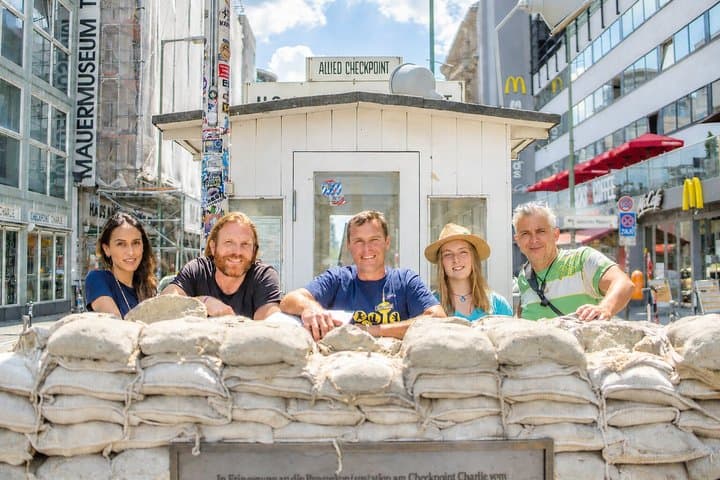
Friedrichstrasse runs through Berlin as a north-south axis. A popular shopping mile developed between Checkpoint Charlie and Friedrichstrasse station after the fall of the wall.
The square was created at the end of the 17th century according to plans by Johann Arnold Nering. At that time, French immigrants, mainly French Protestants (Huguenots), settled in this area. The market place was first called Esplanade, then in chronological order Lindenmarkt, Friedrichstädtischer Markt and Neuer Markt. Finally it was renamed Gendarmenmarkt in 1799, since from 1736 to 1782 the guard and the stables of the "Gens d'armes" ward regiment were located there.
The permanent exhibition "Ways - wrong trails - detours" in the German Cathedral shows the historical development of liberal parliamentary democracy in Germany on five floors.
The Konzerthaus am Gendarmenmarkt is a masterpiece of classicist architecture and is one of Karl Friedrich Schinkel's main works. As early as 1776, at the instigation of Frederick the Great, a small comedy house was opened here, which was designed according to the plans of the Prussian director of construction, Johann Bouman the Elder. was built. The renaming to the Royal National Theater in 1787 illustrated the rise to one of the leading theaters in the country
Between the Spree and the Kupfergraben is the world-famous Museum Island, whose buildings house the archaeological collections and the art of the 19th century. The starting point of the ensemble comprising numerous buildings was the completion of the Old Museum, built according to plans by Schinkel, in 1830.
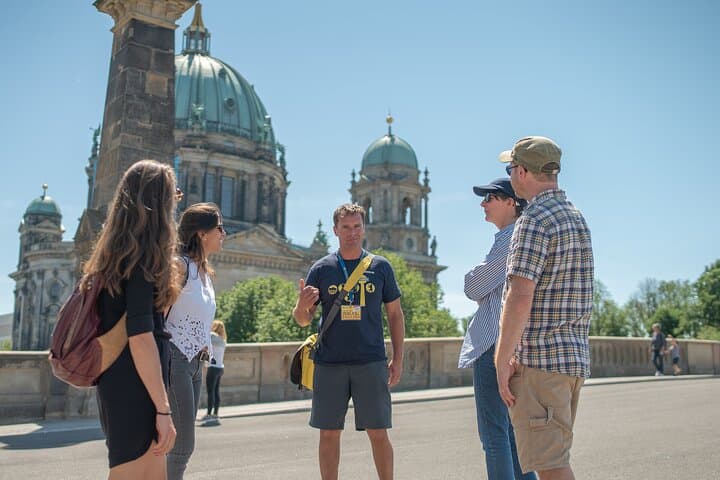
The mighty Berlin Cathedral in the heart of the city cannot be overlooked thanks to its striking dome. A visit to the cathedral is not only a must for every church lover, because it is richly decorated outside and inside - after climbing the dome, visitors are offered an exciting view of the Berlin city center with the Spree, Lustgarten and Museum Island.
The pleasure garden, which initially belonged to the city palace, is located between Karl-Liebknecht-Straße, Kupfergraben, the Altes Museum and the Berlin Cathedral. It is one of the traditional places in the city. Today there are two double rows with linden trees and a huge red granite bowl. In the summer, tourists relax on the lawns or cool off at the fountain in the middle of the pleasure garden.
Reviews are hosted by Viator
This rating summarises the reviews collected by Viator, which keeps them on its own listing. We show the average exactly as it reaches us, without the individual comments.
Read the reviews on Viator