Medieval Tour in Nuremberg in Spanish
5,0 (1679)2h30Nuremberg, Germany
From€20
This self-guided walking tour of Nuremberg allows you to explore the city at your own pace using an audio guide on your smartphone. It is suitable for individuals or small groups who have 2-3 hours to discover the city. The tour covers key attractions such as The Imperial Fortress, Fortress wall and towers, Albrecht Dürer's House, Craftsmen's Court, notable churches, and scenic views of the tiled roofs. After downloading the app, you can use it offline, and it is recommended to listen with headphones for an immersive experience. This option is ideal for those short on time who wish to take in the highlights of Nuremberg without being part of a larger group.
Nuremberg Central Station (Nürnberg Hauptbahnhof) is a grand entry point to the city, blending 19th-century architecture with modern functionality. Its historic stone façade hides a sleek, efficient interior filled with shops, eateries, and bustling platforms serving regional and international trains. A hub since 1844, it’s where Gothic towers meet high-speed rails. Whether you're arriving for Christmas markets or medieval alleys, the station stands as both gateway and anchor to Nuremberg’s layered identity.
The Handwerkerhof Nürnberg is a charming pocket of medieval nostalgia tucked just inside the old city walls near the central station. Built in 1971 within a restored bastion, it recreates the feel of a 16th-century artisan quarter, complete with half-timbered houses, cobbled lanes, and traditional craft shops. Goldsmiths, glassblowers, leatherworkers, and toy makers practice their trades here, while cozy taverns serve bratwurst and Franconian beer. Though a bit staged, it offers a warm, tangible link to Nuremberg’s guild heritage — quiet, curious, and full of handmade soul.
The Straße der Menschenrechte (Street of Human Rights) is a powerful open-air installation in Nuremberg, created by Israeli artist Dani Karavan. Located next to the Neues Museum, it features 27 white concrete pillars, each inscribed with one article of the Universal Declaration of Human Rights in both German and another language. Once the site of Nazi rallies, the street now stands as a firm statement of remembrance and commitment. Walking through it is both quiet and unsettling — a sculptural reminder that dignity must be defended, step by step.
The White Tower (Weißer Turm) is a medieval gate tower that once formed part of Nuremberg’s second city wall. Dating to the 13th century, it now rises oddly beside a modern U-Bahn station bearing its name. Despite the clash of old and new, the tower remains a sturdy witness to the city's layered history—its pale stone walls weathered but proud. Just steps away is the famous marriage carousel fountain, adding a surreal twist to the setting. The White Tower stands as both relic and landmark, quietly anchoring the chaos around it.
The Ehekarussell (Marriage Carousel) in Nuremberg is a wild, surreal fountain that pulls no punches. Created by sculptor Jürgen Weber in 1984, it sits near the White Tower and depicts the stages of marriage — passion, routine, conflict, decay — with six dramatic bronze groupings inspired by 16th-century poet Hans Sachs. Some figures are tender, others grotesque or grimly funny. Water gushes through scenes of love, struggle, and mortality. It’s not romanticized — it’s raw, honest, theatrical. A marriage of sculpture and satire, bold enough to make you blush or laugh out loud.
The Wasserturm (Water Tower) in Nuremberg, part of the ensemble with the Weinstadel, stands as a solid medieval sentinel along the Pegnitz River. Built in the 13th century, it was once part of the city’s fortifications, later used for various civic functions—including as a prison. Its cylindrical stone structure, red-tiled roof, and reflection in the water make it one of the Altstadt’s most photographed landmarks. Quietly stoic, the Wasserturm anchors the romantic riverside view with a touch of old-world strength and mystery.
The Weinstadel in Nuremberg is a stunning half-timbered building along the Pegnitz River, dating back to 1446. Originally a wine storehouse, it later served as a shelter for lepers during Holy Week and eventually housed the city’s poor. With its intricate woodwork, steep gables, and riverside arcades, it’s one of the best-preserved medieval structures in the city. Today, it serves as student housing — a rare case of 15th-century architecture with 21st-century roommates. Its reflection in the water makes it a postcard come to life.
The Spielzeugmuseum Nürnberg (Nuremberg Toy Museum) is a delightful journey through centuries of play, fittingly located in a city once known as the “toy capital of the world.” Housed in a charming Renaissance building, its vast collection spans wooden toys, dolls, tin soldiers, board games, and LEGO, from antique to modern. There's a nostalgic hum in the air — part childhood memory, part cultural reflection. The museum doesn’t just display toys; it shows how they mirror society, invention, and imagination. For kids and grown-ups alike, it’s pure, curated joy.
Weißgerbergasse is one of Nuremberg’s most photogenic streets — a cobbled lane lined with over 20 beautifully preserved half-timbered houses, many dating back to the 15th and 16th centuries. Named after the tanners (“Weißgerber”) who once worked here, the street survived WWII bombings and now glows with colorful facades, flower boxes, and quiet charm. It’s a rare glimpse of pre-modern Nuremberg, untouched by war or time. Today, it’s home to cafés, galleries, and private residences — a lived-in fairytale with creaky floors and centuries in the walls.
Nuremberg’s City Wall is one of the best-preserved medieval fortifications in Europe, encircling the Altstadt in a near-complete 5-kilometer loop. Built and expanded between the 12th and 16th centuries, it features towers, gates, bastions, and a covered walkway once patrolled by watchmen. The walls defended a wealthy imperial city—and still evoke a sense of medieval power. You can walk stretches of it, especially near the Moat Garden, or admire its layered stonework from below. It’s not just a barrier — it’s a living timeline in stone and shadow.
The Albrecht Dürer House is where Germany’s most celebrated Renaissance artist lived and worked for nearly 20 years. Located at the foot of Nuremberg Castle, this 15th-century timbered house is beautifully preserved, with creaky floors, leaded windows, and a workshop where Dürer etched genius into copper and wood. Inside, you’ll find period furnishings, facsimiles of his work, and even a printing press demonstration. It’s not just a museum — it’s a deeply personal space where you sense the quiet rhythm of creativity in every beam and brushstroke.
The Historic Art Bunker (Historische Kunstbunker) is one of Nuremberg’s best-kept secrets — hidden beneath the castle in a maze of medieval rock-cut cellars. During World War II, these tunnels were reinforced and transformed into a secure vault to protect the city’s cultural treasures, including Dürer’s works, imperial regalia, and church art. Today, guided tours lead you through this cold, echoing labyrinth, telling stories of curators, soldiers, and silent masterpieces waiting out the bombs. It’s history beneath history — quiet, chilling, and utterly fascinating.
St. Sebaldus' Church (Sebalduskirche) is one of Nuremberg’s oldest and most revered churches, dating back to the 13th century. Built in Romanesque and Gothic styles, it was dedicated to St. Sebaldus, the city’s patron saint, whose ornate bronze shrine by Peter Vischer is a masterpiece of German Renaissance sculpture. The church’s weathered exterior bears scars from WWII, while inside, light filters through towering stained glass onto stone columns and silent pews. It's a space of endurance, artistry, and quiet reverence at the city’s medieval core.
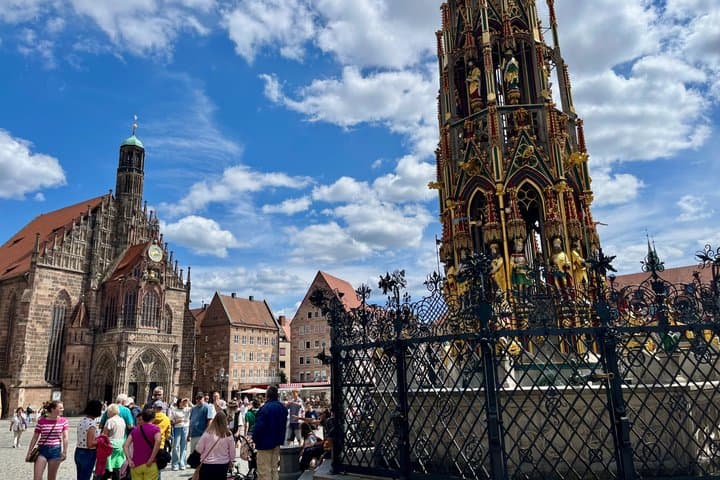
Nuremberg’s Weihnachtsmarkt, or Christkindlesmarkt, is one of the oldest and most famous Christmas markets in the world. Held on the Hauptmarkt since at least the 16th century, it transforms the square into a glowing maze of red-and-white stalls selling spiced gingerbread, mulled wine, handcrafted ornaments, and the city’s beloved Nürnberger bratwurst. At its heart is the golden-haired Christkind, who opens the market with a poetic prologue. It’s festive, fragrant, and timeless — where winter magic tastes like cinnamon and sounds like sleigh bells.
The Fleischbrücke (Meat Bridge) is Nuremberg’s oldest surviving stone bridge, built in 1598–1599 to link the bustling Marktplatz with the Lorenz quarter. Elegant and sturdy, it spans the Pegnitz River in a single graceful arch — an engineering marvel of its time, inspired by Venice’s Rialto Bridge. Named after the nearby butcher stalls, it once teemed with merchants and meat traders. Today, it’s a quiet crossing with perfect views of the city’s riverside charm, bearing centuries of footfall with unshaken poise.
St. Lawrence Church (Lorenzkirche) is Nuremberg’s grand Gothic cathedral, rising in soaring stone just beyond the Pegnitz River. Built from the 13th to 15th centuries, it stuns with its twin towers, intricate rose window, and richly carved portal. Inside, sunlight pours through vast stained-glass windows, illuminating treasures like the Angelic Salutation by Veit Stoß, a suspended marvel of carved wood and gold. Though damaged in WWII, it was lovingly restored — still a place of awe, sound, and silence in the city's southern soul.
Reviews are hosted by Viator
This rating summarises the reviews collected by Viator, which keeps them on its own listing. We show the average exactly as it reaches us, without the individual comments.
Read the reviews on Viator