Toulouse Food & History Tour with a Chef
5,0 (634)4hToulouse, France
From€110
On this interactive walking tour in Toulouse, participants navigate terracotta streets while solving riddles related to the history of the city. The experience includes visiting iconic locations such as the Place du Capitole, where travelers can find the hidden Occitan cross. Guests will also explore the Basilica of Saint-Sernin, noted for being Europe's largest Romanesque church and a significant stop on the Camino de Santiago. The tour features hidden courtyards and the Hôtel d'Assezat, showcasing the city's Renaissance architecture. Participants will walk along the banks of the Garonne River and see the Pont Neuf, the oldest bridge in the city. The tour allows for flexibility, enabling guests to start at their convenience and take breaks as desired. The objective is to solve riddles related to the Capitouls and uncover the treasure of the Pink City. This experience is suitable for those who enjoy historical exploration and interactive challenges.
Toulouse Cathedral is a Roman Catholic church located in the city of Toulouse, France. The cathedral is a national monument, and is the seat of the Archbishop of Toulouse. The exact date of the original building is unknown; the first mention of a church edifice on that site is found in a charter of 844. In 1073 the bishop of Toulouse commenced work on a more elaborate structure, followed by additional construction in the 13th century. It has been listed since 1862 as a monument historique by the French Ministry of Culture. Here you will have to look around to find the answer to our challenge to advance to the new location and learn the story of this place.
The Musée des Augustins de Toulouse is a fine arts museum in Toulouse, France which conserves a collection of sculpture and paintings from the Middle Ages to the early 20th century. The paintings are from throughout France, the sculptures representing Occitan culture of the region with a particularly rich assemblage of Romanesque sculpture. Here you will have to look around to find the answer to our challenge to advance to the new location and learn the story of this place.
Place de la Trinité was built between 1824 and 1826. Designed by the famous urban architect Urbain Vitry, it was ornamented by the Parisian sculptor Alexandre Romagnési. Here you will have to look around to find the answer to our challenge to advance to the new location and learn the story of this place.
The Hôtel d'Assézat was likely built by Toulouse architect Nicolas Bachelier for Pierre d'Assézat, an internationally renowned Toulouse woad merchant. The construction of the Hôtel began in 1555 and was not yet completed when Pierre d'Assézat died in 1581. Here you will have to look around to find the answer to our challenge to advance to the new location and learn the story of this place.
The Jacobins Convent is a jewel of medieval art. A gigantic building that is both sober and original, it is home to a church that is unique in its genre. With an austere exterior, it astonishes visitors once inside with its luminosity, the lightness of its vaults and its double nave that ends with a spectacular stone palm tree with 22 leaf veins. Here you will have to look around to find the answer to our challenge to advance to the new location and learn the story of this place.
Notre-Dame du Taur is a Roman Catholic church located in Toulouse, France. According to legend, the edifice was built on the exact spot where the body of Saint Saturnin (Sernin), patron saint of Toulouse, became detached from the bull that dragged the martyr to his death. Here you will have to look around to find the answer to our challenge to advance to the new location and learn the story of this place.
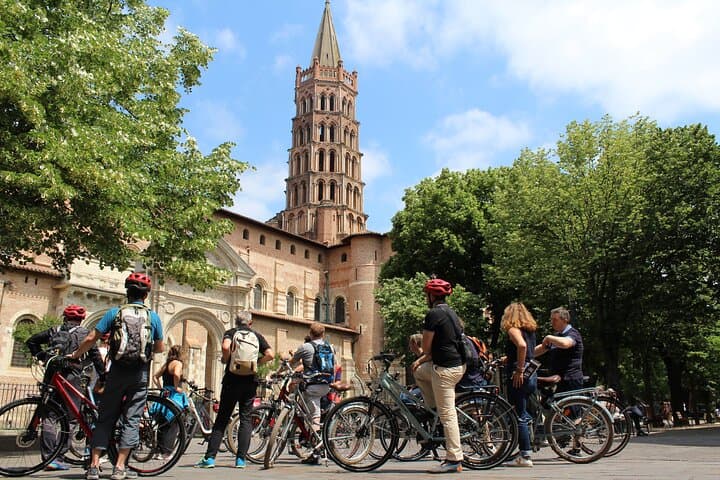
The largest Romanesque church in France, this monumental gem listed as World Heritage by UNESCO has welcomed pilgrims for centuries along the Way of St James. One of the symbols of Toulouse, this basilica of brick and stone is certainly imposing. Majestic and luminous, it was built between the XI and XIV Centuries in honour of St Saturnin (or Sernin), the first bishop of the city. An important stop along the pilgrimage route to Santiago de Compostela, it inspires reverence and its vast proportions are ideal for strolling past the numerous reliquaries. Here you will have to look around to find the answer to our challenge to advance to the new location and learn the story of this place.
Reviews are hosted by Viator
This rating summarises the reviews collected by Viator, which keeps them on its own listing. We show the average exactly as it reaches us, without the individual comments.
Read the reviews on Viator