Berlin's Best: 2 Hour Walking Tour Third Reich and the Cold War
5,0 (6204)2hBerlin, Germany
From€20
This 2.5-hour boat tour explores the historical border of East Berlin, highlighting significant sites and changes along the Spree River. Travelers will view the East Side Gallery, a 1.3 km long section of the Berlin Wall known for its vibrant murals, many of which are currently being restored. The journey includes notable landmarks such as the Oberbaumbrücke, the Osthafen, and the Molecule Men, as well as a passage through the Mühlendammschleuse. The tour also covers the parliament and government district, featuring the Reichstag building and the Federal Chancellery. This experience is suitable for those interested in Berlin's history and urban development, but may not be ideal for individuals seeking an active adventure or those uncomfortable on water.
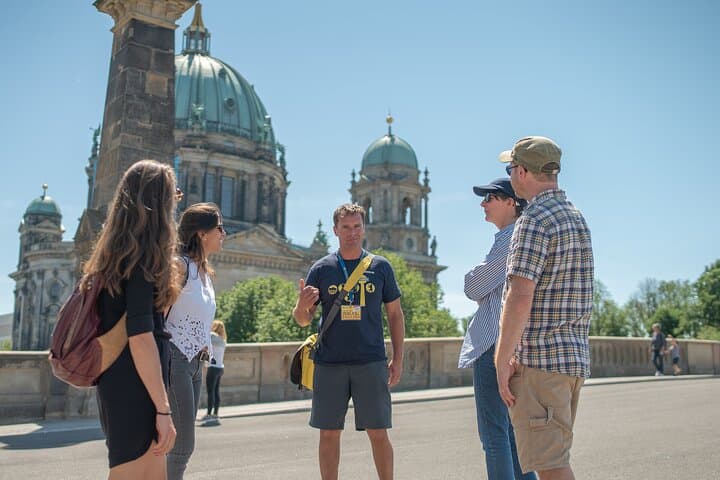
The Berlin Cathedral (officially: Oberpfarr- und Domkirche zu Berlin) at the Lustgarten on the Museum Island is a Protestant church in the Berlin district of Mitte. Built in the years 1894-1905 according to designs by Julius Raschdorff in Neo-Renaissance and Neo-Baroque style, the monument is the largest Protestant church in Germany in terms of area and one of the most important dynastic burial sites in Europe
The Humboldt Forum (proper spelling Humboldt Forum) in the Berlin Palace is a universal museum in the Mitte district of Berlin. In addition to the Ethnological Museum and the Museum of Asian Art of the Berlin State Museums, it is also home to the Berlin exhibition of the Berlin City Museum and the Humboldt Laboratory of the Humboldt University of Berlin. In addition, accompanying events, exhibitions and guided tours take place in the facility supported by the Humboldt Forum Foundation in the Berlin Palace.
The East Side Gallery memorial in Berlin-Friedrichshain is a permanent open-air gallery on the longest surviving section of the Berlin Wall on Mühlenstraße between Berlin Ostbahnhof and the Oberbaum Bridge along the Spree. In the spring of 1990, after the opening of the Berlin Wall, this section was painted by 118 artists from 21 countries over a length of 1316 meters. The artists commented on the political changes of 1989/90 in a good one hundred paintings on the side of the wall that used to face East Berlin, using a wide variety of artistic means. Due to urban planning measures, it is no longer preserved in its entirety, and instead of the originals from back then, only the replicas made in 2009 still exist today. The actual border here was the Kreuzberg bank of the Spree. The gallery is located on the so-called Hinterland Wall, which closed off the border area to East Berlin.
A first wooden bridge was at the level of the former city wall, a few kilometers further downstream from the present bridge near the Spreeinsel. The Spree was blocked on both sides except for a narrow passage in the middle with walkable wooden walkways in order to be able to collect customs duties. At night the passage was closed with a thick trunk reinforced with iron nails, the so-called tree. In addition to the lower tree in the west of the city, there was the upper tree in the east. With the relocation of the city limits and the construction of the Berlin customs wall in 1723, a new wooden bridge with flaps for shipping traffic was built in place of the upper tree a little further east by royal order. Here the Stralauer Tor stood as the entrance to Berlin.
The Molecule Man is a Berlin monumental work of art created in May 1999 by the American sculptor Jonathan Borofsky. It is a three-person sculpture that was set up in the Spree between Elsenbrücke and Oberbaumbrücke near the intersection of the three districts of Kreuzberg, Alt-Treptow and Friedrichshain.
The Nikolaiviertel in Berlin's Mitte district is the oldest settlement area in the capital. Almost completely destroyed in World War II, it was rebuilt in 1980-1987 by architect Günter Stahn on behalf of the East Berlin magistrate on the occasion of the city's 750th anniversary. Around the reconstructed Nikolaikirche, an ensemble of historic town houses and correspondingly adapted prefabricated buildings was built on an almost medieval floor plan. The monument is now one of the sights of Berlin.
At 368 meters, the Berlin television tower is the tallest building in Germany and the fifth tallest television tower in Europe. The television tower is located in the park at the television tower in Berlin's Mitte district. When it was completed in 1969, it was the second highest television tower in the world and, with over a million visitors a year, is one of the ten most popular sights in Germany.
The Museum Island is a building ensemble consisting of five museums in the northern part of the Spreeinsel in the historic center of Berlin. It is one of the most important sights in the German capital and one of the most important museum complexes in Europe. Built between 1830 and 1930 on behalf of the Prussian kings according to plans by five architects, it was included in the UNESCO World Heritage List as a whole in 1999. The Museum Island consists of the Old Museum, the New Museum, the Old National Gallery, the Bode Museum and the Pergamon Museum. Since the reunification of Germany, it has been renovated and expanded as part of the Museum Island master plan. On July 12, 2019, the James Simon Gallery opened as a new visitor center. Also in the northern part of the Spreeinsel is the Berlin Cathedral at the Lustgarten, as well as the Humboldt Forum, which is used for museums and culture and was built in the form of the Berlin Palace by 2021.
The Reichstag building (in short: Reichstag; officially: plenary area Reichstag building; unofficially also Bundestag or Wallot-Bau) on the Republic Square in Berlin has been the seat of the German Bundestag since 1999. The building was erected between 1884 and 1894 in Neo-Renaissance style according to plans by the architect Paul Wallot in the Tiergarten district on the left bank of the Spree. It housed both the Reichstag of the German Empire and that of the Weimar Republic. Initially, the Federal Council of the Empire also met there. After severe damage from the Reichstag fire of 1933 and World War II, the building was restored in a modernized form in the 1960s. From 1995 to 1999, the Reichstag was fundamentally redesigned by Norman Foster for permanent use as a parliament building, which was decided in 1991. The German Bundestag meets here. A landmark in the cityscape is the accessible glass dome above the plenary hall based on an idea by Gottfried Böhm.
The Kronprinzenbrücke is a road bridge that spans the Spree and connects the districts of Mitte and Tiergarten in Berlin's Mitte district with the government district. The structure crosses Konrad-Adenauer-Straße, the continuation of Reinhardtstraße, with two lanes and cycle and pedestrian paths on both sides. The day-care center of the German Bundestag and the Spreebogenpark are directly adjacent to the western end of the bridge.
The Federal Chancellery is a supreme federal authority that supports the German Federal Chancellor in his duties. It has its headquarters or first office in the federal capital of Berlin and its second office in the federal city of Bonn. Wolfgang Schmidt (SPD) is head of the Federal Chancellery and Federal Minister for Special Tasks. The Chancellery currently employs around 600 people (as of 2019). Since 2001, a new building designed by Axel Schultes in Berlin's Spreebogen, separated from the Reichstag building by Platz der Republik, has served as the seat of the authorities. The building opens onto a central square opposite the Paul-Löbe-Haus, which is to be designed as a citizens' forum. It is part of the "Bund des Bunds" group of buildings at the Spreebogenpark. Employees of the Minister of State for Culture are also currently working in the building.
The House of World Cultures (HKW) is an exhibition space in Berlin for international contemporary art and a forum for current developments and discourses. It presents artistic productions from all over the world with a special focus on non-European cultures and societies. Since it was founded in March 1989, the House of World Cultures has been based in the former congress hall on the banks of the Spree in the Tiergarten and government district. As an icon of architectural modernism, the Congress Hall became a prominent symbol of the German-American alliance. In the vernacular of Berlin, the building is also known under the name "Pregnant Oyster" based on its shape.
Palace of Tears is the colloquial name for the former departure hall of the border crossing point Bahnhof Friedrichstrasse in Berlin's Mitte district. From here, S-Bahn and U-Bahn trains ran to West Berlin and long-distance trains via West Berlin to the Federal Republic. The name “Palace of Tears” came about because East Germans used to say goodbye to their western visitors in tears. As a rule, they themselves were not free to travel to the Federal Republic. The control and check-in counters were in the Palace of Tears, manned by employees of the Ministry for State Security in the uniforms of the GDR border troops.
Reviews are hosted by Viator
This rating summarises the reviews collected by Viator, which keeps them on its own listing. We show the average exactly as it reaches us, without the individual comments.
Read the reviews on Viator