Marseille Food Tour – Full Meal of Local Tastes
4,8 (641)3h30Marseille, France
From€74
Explore Marseille at your own pace with the TouringBee audio guide, which is designed for a 2-3 hour walking tour. The app provides a mapped route from the Arc de Triomphe to the Basilica of Notre Dame de la Garde, highlighting key sights such as The Old Port, Fort Saint-Jean, Marseille Cathedral, The Street Art of Le Panier, Vieille-Charité Almshouse, petanque fields, and the charming narrow streets filled with souvenirs. This tour is suitable for those who prefer a self-guided experience and want to learn about the city without the constraints of a group. It is not ideal for travelers who prefer in-person guidance or structured tours. Before booking, note that the app works offline once downloaded, allowing for uninterrupted listening through headphones. This tour is best for individuals or small groups looking to efficiently explore Marseille's highlights.
Porte d’Aix in Marseille is a triumphal arch built in the 19th century to commemorate French military victories. Inspired by Roman arches, it features classical columns and detailed reliefs celebrating battles from the Revolution and Napoleonic era. Located at the historic entrance to the city, near the former road to Aix-en-Provence, it once marked Marseille’s northern gateway. Today, it stands as a proud symbol of civic memory and neoclassical grandeur in the heart of the city.
The Huveaune Aqueduct in Marseille is a historic structure built to carry water across the Huveaune River valley. Dating from the 19th century, it was part of the city’s efforts to modernize its water supply during a time of rapid growth. With its elegant arches and solid stone construction, the aqueduct blends functionality with architectural grace. Though no longer in full use, it remains a striking reminder of Marseille’s industrial and engineering heritage.
The Vieille Charité in Marseille is a stunning 17th-century building originally constructed as an almshouse for the poor. Designed by Pierre Puget, its Baroque architecture centers on a peaceful courtyard and a domed chapel made of pink and white stone. Today, it houses museums, art exhibitions, and cultural institutions, including the Museum of Mediterranean Archaeology. Located in the historic Panier district, it’s both a cultural hub and a serene architectural gem in the heart of the city.
Église Saint-Laurent is one of Marseille’s oldest churches, dating back to the 12th century. Built in the Romanesque style with warm pink stone, it once served the city’s fishing community. Perched above the Old Port, it offers beautiful views of the harbor and the modern Mucem nearby. Its simple, fortress-like façade hides a quiet, spiritual interior. The church stands as a peaceful witness to Marseille’s maritime past and its layered, centuries-old history.
Marseille Cathedral (Cathédrale La Major) is a monumental 19th-century basilica that blends Romanesque and Byzantine styles, making it one of the largest churches in France. Built on the site of an earlier medieval cathedral, it features striped stonework, grand domes, and richly decorated interiors. Overlooking the sea near the Old Port, it stands as a symbol of Marseille’s Mediterranean identity—both spiritual and architectural. Its massive scale and unique design make it a must-see landmark in the city.
Fort Saint-Jean is a historic coastal fortress guarding the entrance to Marseille’s Old Port. Built in the 17th century on the site of earlier medieval and crusader structures, it served both military and ceremonial functions. Its ramparts, towers, and views over the sea make it a dramatic reminder of the city’s strategic maritime past. Now part of the Mucem complex, the fort is accessible via footbridges and hosts exhibitions, gardens, and panoramic walkways linking history with modern Marseille.
The Hôtel de Ville de Marseille, or City Hall, is a beautiful 17th-century building located on the edge of the Old Port. Built in 1656, it reflects Genoese Baroque influence, with an elegant pink stone façade, ornate windows, and no internal staircase—access between floors is via a hidden external passage. It has been the seat of the city’s government for centuries and remains a functioning administrative building. Facing the harbor, it symbolizes Marseille’s long-standing role as a maritime and civic power.
The Church of the Accoules (Église des Accoules) is a historic church tucked into Marseille’s Le Panier district. Originally founded in the early Middle Ages, it was destroyed during the French Revolution and later rebuilt in the 19th century. Its most striking feature is the tall Gothic-style bell tower, preserved from the original medieval structure. Once a center of revolutionary activity, the church now stands as a quiet symbol of the city's resilience and layered religious history.
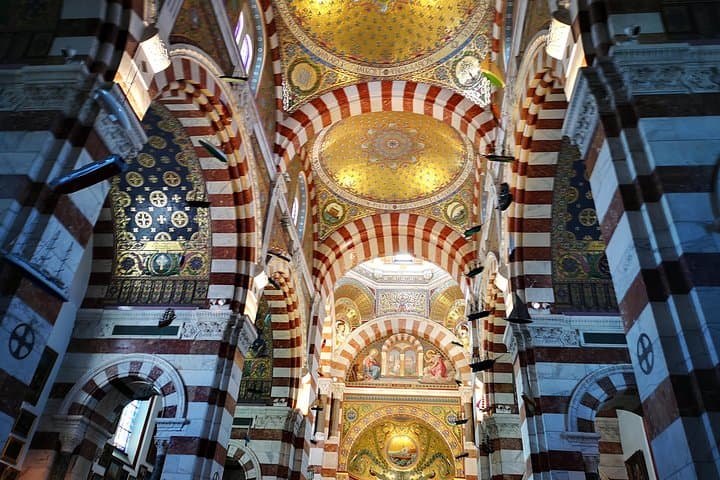
Notre-Dame de la Garde, perched atop Marseille’s highest hill, is the city’s most iconic landmark and spiritual protector. Built in the 19th century in Romano-Byzantine style, the basilica features elaborate mosaics, marble interiors, and a towering bell tower crowned by a golden statue of the Virgin Mary holding the infant Jesus. Known locally as la Bonne Mère, it watches over sailors and citizens alike. The panoramic views from the terrace stretch across Marseille, the sea, and the islands beyond—offering both a breathtaking vista and a moment of reflection.
Château d’If is a 16th-century fortress-turned-prison located on a small island just off the coast of Marseille. Built by King Francis I to defend the city, it gained fame as the fictional prison in Alexandre Dumas’ The Count of Monte Cristo. Over the centuries, it held political and religious prisoners, becoming a symbol of isolation and escape. Today, visitors can tour its stark cells and ramparts, with sweeping views of the Mediterranean. Accessible by boat from the Old Port, the château offers a powerful blend of history, myth, and maritime drama.
Reviews are hosted by Viator
This rating summarises the reviews collected by Viator, which keeps them on its own listing. We show the average exactly as it reaches us, without the individual comments.
Read the reviews on Viator