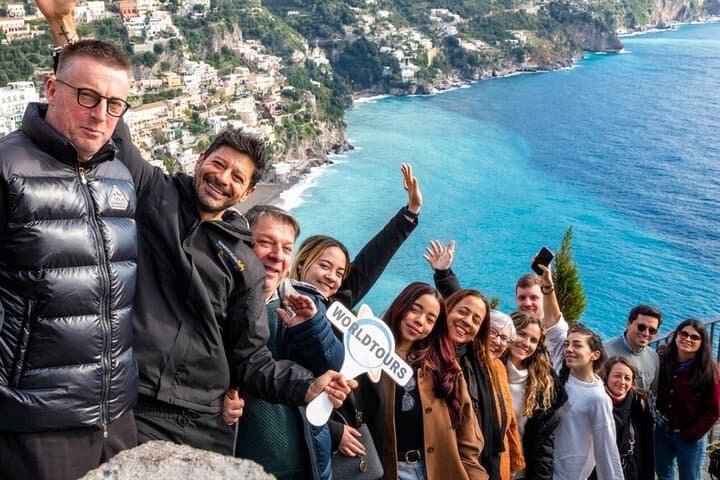
Amalfi Coast Positano & Sorrento Group Tour From Naples
4,8 (10963)8hNaples, Italy
From€81
This tour starts in Positano, where travelers will explore narrow streets lined with boutiques and craft shops while enjoying views from the surrounding mountains. The local cuisine, known for fresh fish and Mediterranean vegetables, is also a highlight. The journey continues to Sorrento, located on the Sorrento peninsula, where visitors will have the chance to see the historic center, including the Cathedral of Sorrento, Baroque churches, and the Cloister of San Francesco. Sampling limoncello, a local lemon liqueur, is recommended. The final stop is Pompeii, the ancient city that was buried by the eruption of Vesuvius in 79 AD. Travelers will learn about the daily lives of its inhabitants and view well-preserved frescoes, mosaics, and buildings. This tour is suitable for those interested in history and culture, but may not be ideal for individuals with mobility issues due to the walking involved.
Meta di Sorrento is a perfect panoramic stop to admire the beauty of the Sorrentine Peninsula. Standing 111 meters above sea level, it offers spectacular views of Capri, Sorrento, and the Amalfi Coast, with vistas stretching from turquoise waters to the green hills surrounding the area. From this viewpoint, you can capture the very essence of the coastal landscape — golden beaches, cliffs, and gentle slopes descending toward the sea. A short but unmissable photo stop along the route to Sorrento.
The Li Galli islands form a tiny archipelago between Capri and Positano, one of the most evocative places not only in Campania, but in the entire Mediterranean. The archipelago consists of three islands, Gallo Lungo, La Rotonda, and La Castelluccia, which together form an extremely picturesque marine protected area.
Positano is perhaps a unique place in the world! It is a jewel of spontaneous architecture, nestled on the rocks overlooking the sea. Clusters of colorful houses, sometimes cubic in appearance, are built on often steep steps that descend to the beach, connected by alleys and long stairways.
Legend has it that the mythical Sirens lived in its sea and tempted Ulysses with their melodious song. And even today, when you go out onto that sea—with its blue and green reflections, in a thousand different shades depending on the play of the sun—you can imagine the Sirens emerging from the waves, beautiful and persuasive. But perhaps it is Sorrento itself that captivates and enchants with the scents of lemon and orange trees, with olive trees with dark, twisted trunks and silver leaves that move slowly, with a soft sound, in the wind coming from the sea, with rocks born from the distant fury of a volcano.
Pompeii is a city in Campania, located in the Gulf of Naples and on the slopes of Mount Vesuvius. It is a city with ancient origins: it began as an Oscan settlement, was later inhabited by the Samnites, and then, starting in the first century BC, was conquered by the Romans. A city buried by the eruption of Vesuvius. Today it is known as the city with one of the most important archaeological sites in the world. The Roman city was buried by lava following the eruption of Vesuvius in 79 AD. The lava and ash acted as a kind of cover that allowed the city to be preserved over the centuries and protected from the elements; for this reason, the city has remained intact and can be visited today. Note: the remaining time is for the round trip and the time spent between attractions.
Reviews are hosted by Viator
This rating summarises the reviews collected by Viator, which keeps them on its own listing. We show the average exactly as it reaches us, without the individual comments.
Read the reviews on Viator