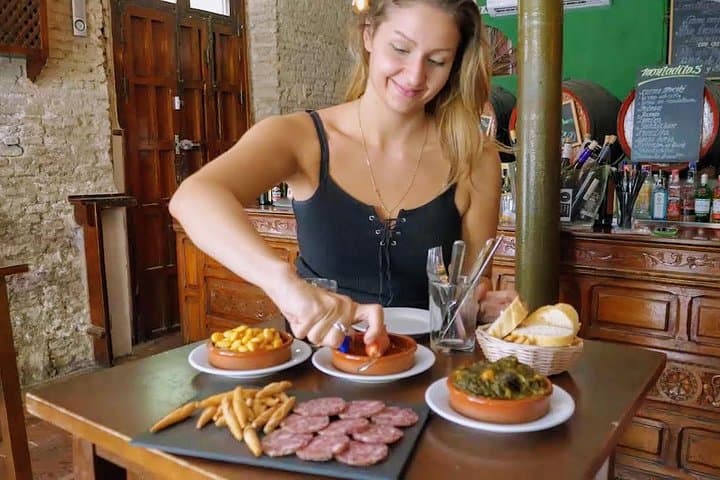
Sevilla Food Tour: Tapas, Wine, History & Traditions
4,9 (5682)3h30Seville, Spain
From€69
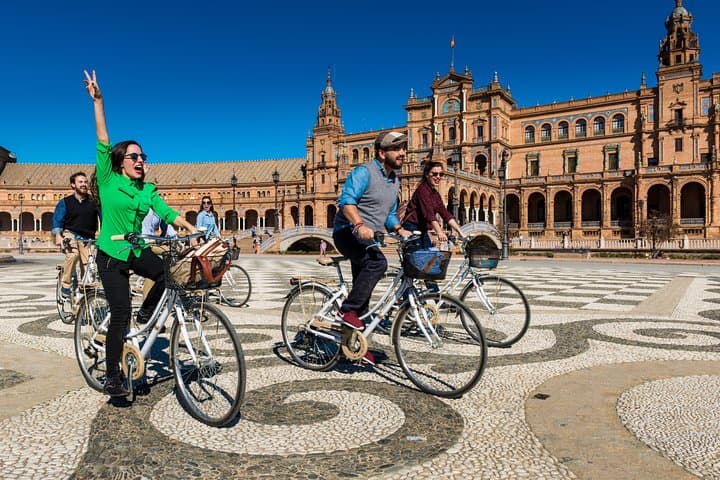
This 2.5-hour electric bike tour in Seville involves riding through various neighborhoods and landmarks including Santa Cruz, María Luisa Park, Plaza de España, Torre del Oro, and Triana. The tour is conducted in small groups of up to 10 travelers, making it suitable for those who prefer a more intimate experience. It may not be ideal for individuals who are uncomfortable riding a bike or prefer not to engage in group activities. The tour includes the use of an electric bicycle and a helmet, allowing for a leisurely pace with regular stops for insights and photos.
Most of the grounds that were used for the park were formerly the gardens of the Palace of San Telmo. They were donated to the city of Seville in 1893 by the Infanta Luisa Fernanda, Duchess of Montpensier, for use as a public park. In 1914 the architect Aníbal Gonzalez began construction for the Ibero-American Exposition of 1929, which was held partly within the park. The centre of it is Parque de María Luisa, a 'Moorish paradisical style' with a half mile of tiled fountains, pavilions, walls, ponds, benches, and exhedras. There are lush plantings of palms, orange trees, Mediterranean pines, and stylized flower beds with bowers hidden by vines. The park serves as a botanical garden. Many plant species, native or exotic, are represented, along with educational panels to inform the visitors to the park. Many birds make their home in the park, which is known for its large population of doves .
The Plaza de España ("Spain Square", in English) is a plaza in the Parque de María Luisa (Maria Luisa Park), in Seville, Spain. It was built in 1928 for the Ibero-American Exposition of 1929. It is a landmark example of Regionalism Architecture, mixing elements of the Baroque Revival, Renaissance Revival and Moorish Revival (Neo-Mudéjar) styles of Spanish architecture.
The Torre del Oro (English: "Tower of Gold") is a dodecagonal military watchtower in Seville. It was erected by the Almohad Caliphate in order to control access to Seville via the Guadalquivir river. Constructed in the first third of the 13th century, the tower served as a prison during the Middle Ages. Its name comes from the golden shine it projected on the river, due to its building materials (a mixture of mortar, lime and pressed hay). The tower is divided into three levels, the first level, dodecagonal, was built in 1220 by order of the Almohad governor of Seville, Abù l-Ulà; As for the second level, of only 8 meters, also dodecagonal, was built by Peter of Castile in the fourteenth century, a hypothesis that has been confirmed by archaeological studies; The third and uppermost being circular in shape was added after the previous third level, Almohad, was damaged by the 1755 Lisbon earthquake. Rebuilding of the third level was made by Brusselian Sebastian Van der Borcht in 1760.
The Puente de Isabel II, Puente de Triana or Triana Bridge, is a metal arch bridge in Seville, Spain, that connects the Triana neighbourhood with the centre of the city. It crosses the Canal de Alfonso XIII, one of the arms of the River Guadalquivir that isolate Triana as an almost-island. It was built during the reign of Isabella II of Spain and completed in 1852 as the first solid bridge in Seville, replacing an earlier floating bridge consisting of boats (a pontoon bridge). First built by the Moors in the 12th century, the pontoon bridge managed to exist for seven centuries due to later repairs.[1]
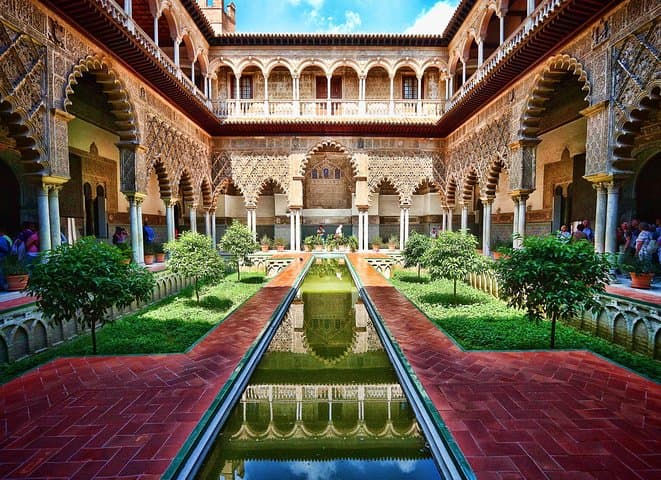
The Royal Alcázars of Seville (Spanish: Reales Alcázares de Sevilla), historically known as al-Qasr al-Muriq (Arabic: القصر المُورِق, The Verdant Palace) and commonly known as the Alcázar of Seville (pronounced [alˈkaθaɾ]), is a royal palace in Seville, Spain, built for the Christian king Peter of Castile. It was built by Castilian Christians on the site of an Abbadid Muslim alcazar, or residential fortress destroyed after the Christian conquest of Seville. The palace is a preeminent example of Mudéjar architecture in the Iberian Peninsula but features Gothic, Renaissance and Romanesque design elements from previous stages of construction. The upper storeys of the Alcázar are still occupied by the royal family when they are in Seville, and are administered by the Patrimonio Nacional. It was registered in 1987 by UNESCO as a World Heritage Site, along with the adjoining Seville Cathedral and the General Archive of the Indies.
Reviews are hosted by Viator
This rating summarises the reviews collected by Viator, which keeps them on its own listing. We show the average exactly as it reaches us, without the individual comments.
Read the reviews on Viator