Dresden Old Town: Small-Group Walking Tour in English
4,8 (204)2hDresden, Germany
From€25
This self-guided audio tour in Dresden focuses on the city's history during the Nazi regime and the destruction caused by the firebombing in February 1945. Participants will walk through significant locations, listening to audio content that provides context about persecution and the impact on democracy. The tour allows for personal reflection and can be completed at your own pace. It lasts for approximately 2 hours of walking and includes 40 minutes of audio material, with 9 stops along the route. It is suitable for individuals interested in historical events but may not be appropriate for those seeking a light or casual experience. Note that no entrance fees are required, as all sites are free to access, and participants will need their own smartphone to use the audio guide without any app downloads.
The Kreuzkirche rises at the southeastern edge of the Altmarkt, the largest church in Saxony and home to one of the world's oldest boys' choirs. Its fire-gutted shell and deliberately bare interior stand as a silent witness to the destruction of February 1945.
Dresden's oldest square, a grand ceremonial stage under the Nazi regime and, after the firestorm of February 1945, the ground where thousands of the dead were cremated on open pyres.
The graceful baroque square at the foot of the Frauenkirche, where not a single house was left standing after the 1945 firestorm. Almost everything you see today has been patiently rebuilt from the ashes.
A grand stone promenade high above the Elbe, long nicknamed the Balcony of Europe, that after February 1945 became a viewpoint over a city reduced to ash.
One of the grandest opera houses in Germany, and a quiet monument to how completely Dresden's cultural life was first corrupted, then extinguished. Burned to a hollow shell in 1945, the Semperoper stood roofless for forty years before it sang again.
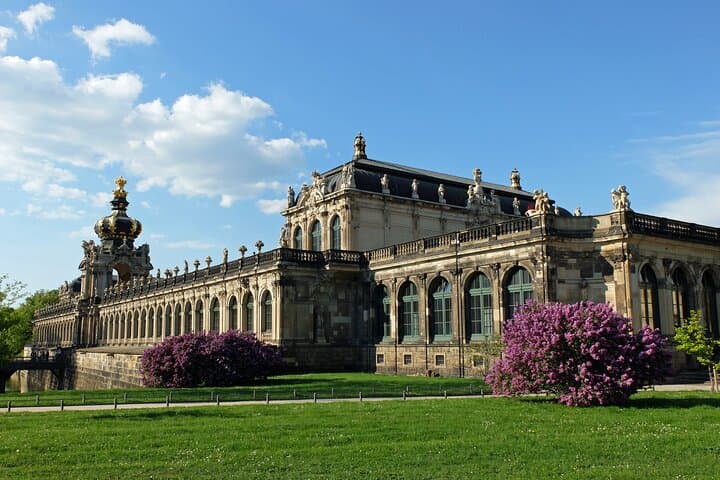
A jewel of Baroque architecture that was gutted to a burnt shell in the 1945 firestorm and painstakingly rebuilt from the rubble. Its galleries once held treasures that vanished into a Soviet railway tunnel before returning a decade later.