Frankfurt Highlights English Walking Tour
4,9 (1358)2h30Frankfurt, Germany
From€30
This bike tour in Frankfurt takes you to notable sights such as the New Old Town, European Central Bank, and Goethehaus. It is suitable for both returning visitors and newcomers to the city. The tour lasts for an unspecified duration and is guided by qualified tour guides who share insider tips about the area. At the end of the tour, participants receive recommendations for authentic Äbbelwoi taverns. No specific group size is mentioned, and any additional inclusions or exclusions are not detailed.
Your bike tour begins in the middle of Sachsenhausen, one of the most popular districts of the city. Many old buildings from the Wilhelminian era shape the face of the quarter with its high density of trendy bars, cozy cafes and a large selection of restaurants and traditional apple wine restaurants. Here, home-style food is served in a rustic ambience. The "Stöffsche" is an essential part of it. In the 19th century Sachsenhausen was still characterized by orchards. This is where the “Äppelwoi” was invented, which has been the epitome of the Hessian way of life, not just since the program “Zum Blauen Bock”.
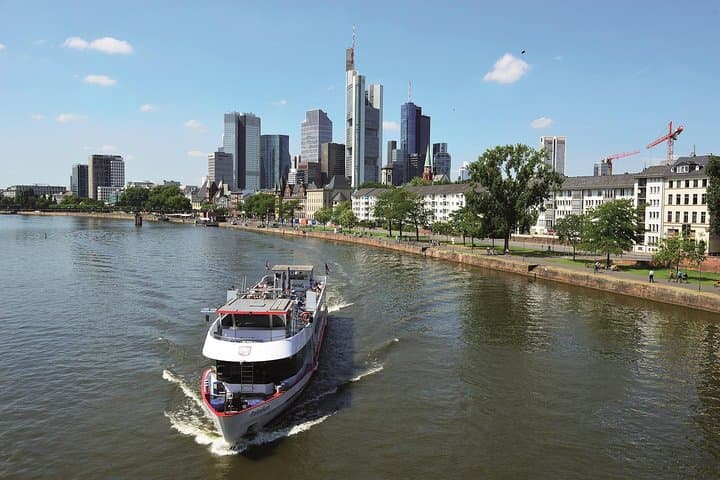
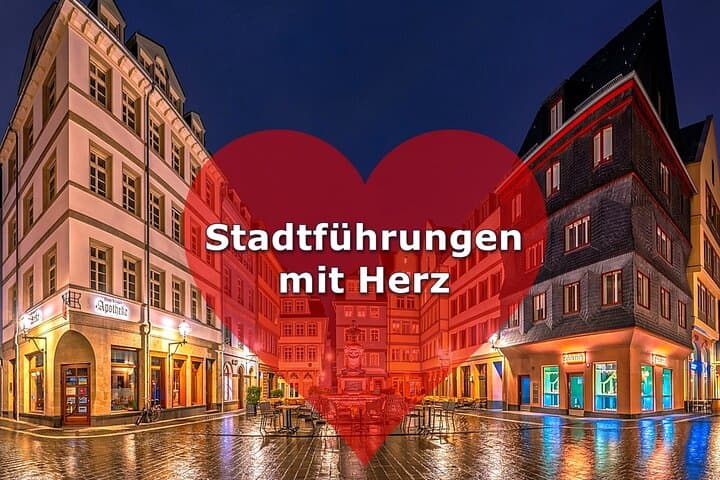
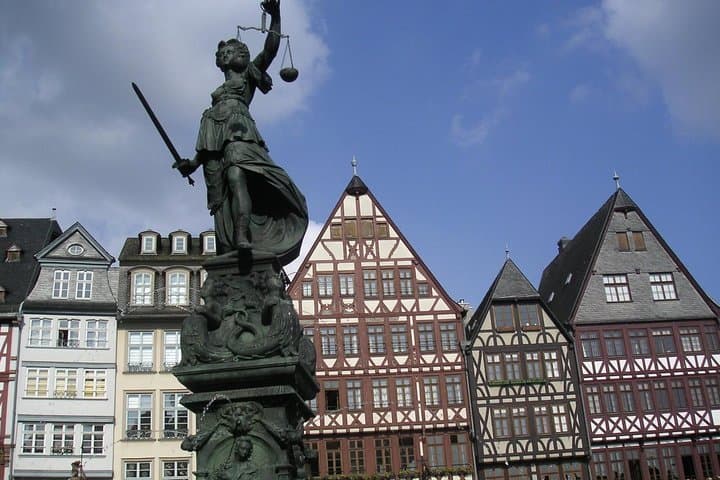
You cycle relaxed through small streets then through the Malerviertel to the south bank of the Main with the famous museum bank. The Städelsche Kunstinstitut with its renowned annex and renowned temporary exhibitions, the Liebieghaus and the Museum of Applied Art are located here. Via the Holbeinsteg you get to the other side of the Main and cycle into the old town of Frankfurt. On the Römer, you can look over the old Königsweg to the Frankfurt "Dom" (which is actually none) and experience the recently completed New Old Town, a successful mixture of reconstructions and new buildings. It is only a few meters to the cradle of German democracy with the Paulskirche. Then you cycle through the Großer Hirschgraben to the residence of the Goethe family. This is where the famous poet was born and spent his youth. He described this period impressively in his autobiography Poetry and Truth.
You cycle relaxed through small streets then through the Malerviertel to the south bank of the Main with the famous museum bank. The Städelsche Kunstinstitut with its renowned annex and renowned temporary exhibitions, the Liebieghaus and the Museum of Applied Art are located here. Via the Holbeinsteg you get to the other side of the Main and cycle into the old town of Frankfurt. On the Römer, you can look over the old Königsweg to the Frankfurt "Dom" (which is actually none) and experience the recently completed New Old Town, a successful mixture of reconstructions and new buildings. It is only a few meters to the cradle of German democracy with the Paulskirche. Then you cycle through the Großer Hirschgraben to the residence of the Goethe family. This is where the famous poet was born and spent his youth. He described this period impressively in his autobiography Poetry and Truth.
You cycle relaxed through small streets then through the Malerviertel to the south bank of the Main with the famous museum bank. The Städelsche Kunstinstitut with its renowned annex and renowned temporary exhibitions, the Liebieghaus and the Museum of Applied Art are located here. Via the Holbeinsteg you get to the other side of the Main and cycle into the old town of Frankfurt. On the Römer, you can look over the old Königsweg to the Frankfurt "Dom" (which is actually none) and experience the recently completed New Old Town, a successful mixture of reconstructions and new buildings. It is only a few meters to the cradle of German democracy with the Paulskirche. Then you cycle through the Großer Hirschgraben to the residence of the Goethe family. This is where the famous poet was born and spent his youth. He described this period impressively in his autobiography Poetry and Truth.
The Paulskirche, originally an emporium building (1789-1833), is the "cradle of German democracy" and the national symbol of freedom and democracy in Germany par excellence. On May 18, 1848, the first freely elected National Assembly convened in Frankfurt's Paulskirche. The following months were marked by work on a constitution for a unified Germany, which, however, later failed due to resistance from Prussia and Austria. The subsequent uprisings to enforce the constitution were put down and the parliament was finally dissolved by force of arms on May 30, 1849. From 1852 until its destruction in 1944, services were again held in St. Paul's Church. On March 18, 1944, the Paulskirche burned down completely after a bombing raid and was rebuilt after the war as Frankfurt's first historic building
Strictly speaking, the "Kaiserdom" is not a cathedral, as it was never the seat of a bishop. The Gothic parish church of St. Bartholomew, which was consecrated to St. Bartholomew in 1239 and rebuilt into a Gothic hall church, only received its honorary name "Kaiserdom" in the 18th century. It dates back to a Carolingian foundation of 852 and was designated in the "Golden Bull" of 1356 as the elective church of the German kings and, from 1562, also of the emperors of the Holy Roman Empire of the German Nation. From 1562 to 1792, 10 imperial coronations took place in Frankfurt Cathedral. The 96m high late Gothic tower was completed only in the course of a fundamental restoration after the great fire of 1867. In the fire all the historic bells of the cathedral also melted. Many paintings from the period after 1870 were lost in the bombing of 1944. With the restoration from 1992 to 1994 the cathedral found its present appearance
The Goethe House on Großer Hirschgraben was the residence of the Goethe family until 1795. Goethe House around 1920 "At the stroke of twelve bells," as Johann Wolfgang Goethe reported in "Poetry and Truth," he was born on August 28, 1749, and spent his youthful years here. In 1795 the family sold the house. After the destruction of the war on March 22, 1944, Goethe's childhood home was rebuilt and furnished with the old furnishings that had been preserved.
The Hauptwache is the city center and the most famous square of the Main metropolis. The square is the real heart of Frankfurt's city center. The baroque guard building, which gives its name to the whole square, was built in 1729-30 by the city architect Johann Jakob Samhaimer as a military station. The Hauptwache was the seat of the city militia and also included a prison. The Hauptwache gained historical significance through the storming of the guard on April 3, 1833, when about 50 young revolutionaries wanted to give a signal for the establishment of a republic. Since 1904, the historic guard building has housed the popular Café Hauptwache. This, and especially the neighboring Normaluhr, became the most famous meeting place for dates in the city center. In 1944, the Hauptwache was completely burned out after heavy 10 bombing raids. In 1954, it was reopened and in 1967, in the course of the construction of the subway, first completely dismantled, and then a year later, rebuilt above the subway station.
Stock Exchange Frankfurt
Alte Oper
Former city wall
European Central Bank
Reviews are hosted by Viator
This rating summarises the reviews collected by Viator, which keeps them on its own listing. We show the average exactly as it reaches us, without the individual comments.
Read the reviews on Viator