Berlin's Best: 2 Hour Walking Tour Third Reich and the Cold War
5,0 (6204)2hBerlin, Germany
From€20
This self-guided audio tour allows you to explore significant sites in Berlin related to World War II and the Nazi regime. You will use your smartphone to navigate and listen to the audio guide, which does not require any app downloads. The tour covers free public sights, so no entrance tickets are necessary. The experience lasts approximately 2 hours of walking with an additional 40 minutes of audio content and includes 10 stops. It is available in English and German. This tour is suitable for individuals interested in history, particularly those looking to understand the complexities of the Holocaust and the impact of the Third Reich. It may not be ideal for those seeking a guided experience or those who prefer a more interactive format.
One of Berlin's busiest rail hubs and the meeting point for our walk. Beneath its bustle lies a divided memory, for this station was both a doorway to rescue for Jewish children and, later, a transit point in the deportation of the city's Jews.
A bronze group of seven children stands outside Friedrichstraße station, frozen between two destinies. Two figures face the trains that carried them to safety in England, while five turn the other way, toward the trains that carried Berlin's Jewish children to their deaths.
The seat of German democracy, crowned by a luminous glass dome. On a winter night in 1933, fire tore through this building and gave the Nazi regime the pretext it needed to dismantle the republic.
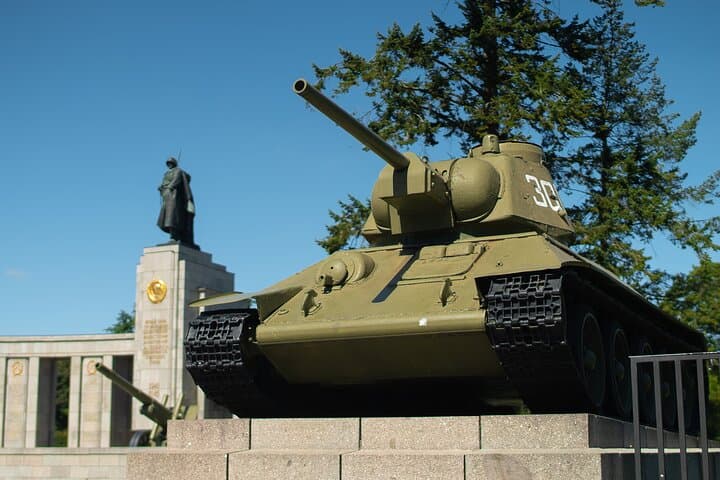
A sweeping curved colonnade crowned by a towering bronze Red Army soldier, flanked by two T-34 tanks and field guns. It marks the graves of more than 2,000 Soviet soldiers who fell taking Berlin in 1945.
Berlin's neoclassical triumphal gate, crowned by the Quadriga chariot, became a backdrop for Nazi propaganda after 1933 and a battered ruin on the front line in 1945. It stands today as a monument to both the city's grandeur and its catastrophe.
Behind a vast modern glass facade on Pariser Platz stand the surviving halls of the old Prussian Academy of Arts. From 1937 these rooms were taken over by Albert Speer, Hitler's chief architect, to draft the megalomaniac plans for a Nazi world capital called Germania.
A vast, undulating field of 2,711 grey concrete stelae just south of the Brandenburg Gate. This is Germany's central memorial to the up to six million Jews murdered in the Holocaust, with an underground Place of Information beneath it.
An ordinary residential car park is all that marks the spot where Adolf Hitler spent the final weeks of the war and took his own life on the thirtieth of April 1945. A single modest information board is the only acknowledgement of what lies buried beneath the asphalt.
On the very ground where the Gestapo and SS once directed a continent-wide machinery of persecution, this documentation centre lays the terror bare. An open trench of excavated cellar walls runs beneath a stark grey hall, beside the longest surviving stretch of the Berlin Wall in the city centre.