Berlin's Best: 2 Hour Walking Tour Third Reich and the Cold War
5,0 (6204)2hBerlin, Germany
From€20
This self-guided audio tour of Berlin allows you to explore the city's must-see landmarks at your own pace. You will walk for 2 hours and listen to 40 minutes of audio as you discover the highlights and hear stories about the German capital's history. The tour includes 10 stops at free public sights, so no entrance tickets are needed. It is suitable for individuals or small groups who prefer a flexible schedule and can navigate using their own smartphones. The audio is available in English and German. No app download is required; you simply access the tour through a link provided in your ticket.
Berlin's oldest university, a Baroque palace turned cradle of modern learning that has counted Einstein, Hegel and the Brothers Grimm among its minds. Across the boulevard stands Schinkel's Neue Wache, where a single rain-washed sculpture mourns all the victims of war.
Berlin's most famous landmark, a serene neoclassical gateway crowned by the winged Quadriga. Once stranded in the no-man's land of the Berlin Wall, it is today the joyful emblem of a reunified city.
Berlin's oldest university, a Baroque palace turned cradle of modern learning that has counted Einstein, Hegel and the Brothers Grimm among its minds. Across the boulevard stands Schinkel's Neue Wache, where a single rain-washed sculpture mourns all the victims of war.
An elegant Enlightenment square laid out by Frederick the Great, ringed by the State Opera, the curved old Royal Library, and St. Hedwig's Cathedral. A glass plate set into the cobbles reveals empty white shelves below, the haunting memorial to the Nazi book burning of May 1933.
An elegant Enlightenment square laid out by Frederick the Great, ringed by the State Opera, the curved old Royal Library, and St. Hedwig's Cathedral. A glass plate set into the cobbles reveals empty white shelves below, the haunting memorial to the Nazi book burning of May 1933.
Widely called Berlin's most beautiful square, a perfect study in symmetry where Schinkel's grand Konzerthaus is flanked by two near-identical domed towers, the German and French Cathedrals. Their twin silhouettes rising above the open paving make this one of the great architectural set pieces in Europe.
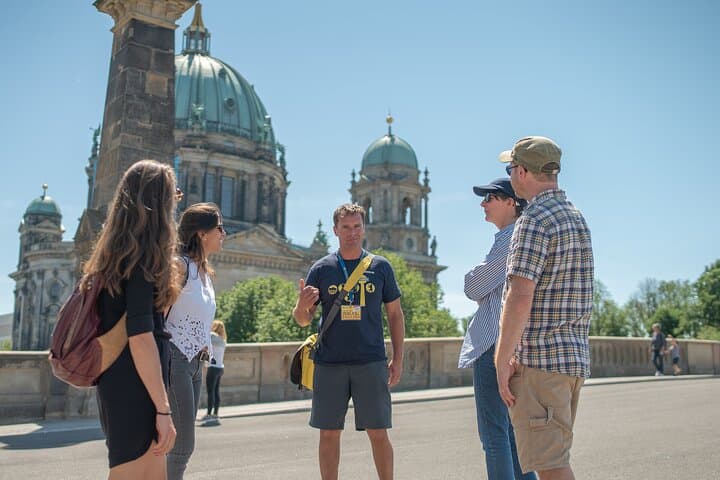
The grand domed Protestant cathedral that rises over the Lustgarten, built in 1905 as a Hohenzollern court church. Beneath its soaring dome lie a royal crypt of nearly a hundred coffins and a viewing gallery looking out across the city's rooftops.
A reconstructed Baroque royal palace housing a museum of world cultures, standing where the Hohenzollern residence once ruled and the GDR later raised its Palace of the Republic. No single building tells Berlin's destroy-and-rebuild story more clearly than this one.
A maze of cobbled lanes and gabled houses clustered around the twin-spired Nikolaikirche, Berlin's oldest church. This is the medieval cradle from which the whole city grew, flattened in the war and lovingly recreated for Berlin's 750th birthday.
A vast, breezy plaza crowned by the soaring Fernsehturm, East Berlin's proud landmark and still the tallest structure in Germany. Around you spread the wide pavements, the spherical fountain and the beloved World Clock, the everyday heart of the modern capital.
A vast, breezy plaza crowned by the soaring Fernsehturm, East Berlin's proud landmark and still the tallest structure in Germany. Around you spread the wide pavements, the spherical fountain and the beloved World Clock, the everyday heart of the modern capital.