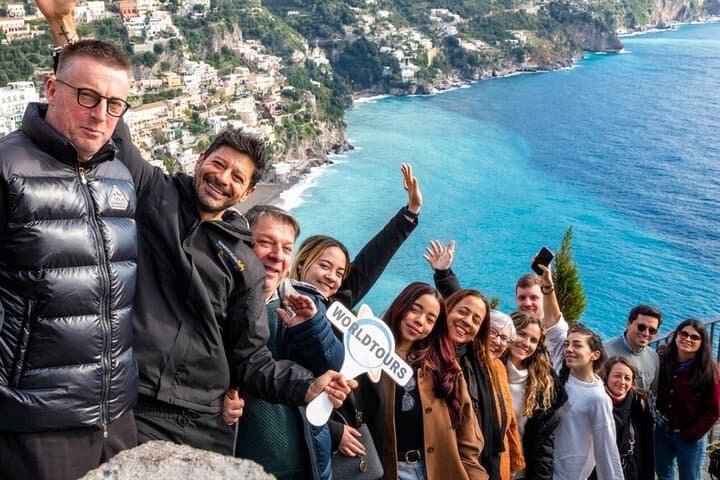
Amalfi Coast Positano & Sorrento Group Tour From Naples
4,8 (10963)8hNaples, Italy
From€81
Join a guided tour of the archaeological site of Pompeii, starting from Naples. This tour includes priority entrance, allowing you to bypass the standard queues. You will explore the ancient streets, known as “cardini” and “decumani,” and visit significant locations such as the baths, streets, bakeries, and forums. The tour highlights the well-preserved frescoes found in the Villas, offering insights into Roman life before the eruption of Mount Vesuvius.
Pompeii is a vast archaeological site in southern Italy’s Campania region, near the coast of the Bay of Naples. Once a thriving and sophisticated Roman city, Pompeii was buried under meters of ash and pumice after the catastrophic eruption of Mount Vesuvius in 79 A.D. The preserved site features excavated ruins of streets and houses that visitors can freely explore.
The Civil Forum is the core of daily life of the city and is the focal point of all the main public buildings for city administration and justice, business management, and trade activities such as markets, as well as the main places of citizen worship.
The Temple of Jupiter dominates the north side of the Forum, with Mount Vesuvius scenically rising behind. When the colony was founded (80 BC), the temple underwent a radical renovation and became a real Capitolium with the three cult statues of Jupiter, Juno and Minerva, which looked like those of the Capitolium in Rome, placed on a high base so as to make them visible to whoever passed in the Forum square.
The House of the Faun (Casa del Fauno) is one of the largest and most luxurious private residences in Pompeii, occupying an entire city block. Named after the iconic bronze statue of a dancing faun found in its main atrium, the house is a masterpiece of Roman architecture and Hellenistic influence. It is most famous for housing the magnificent Alexander Mosaic, which depicts the battle between Alexander the Great and Darius III of Persia. With its two peristyle gardens and intricate floor mosaics, it remains a powerful symbol of the immense wealth and sophisticated taste of the city's elite.
Via dell’Abbondanza was the ancient main street (decumanus maximus) of ancient Pompeii, which ran across the city in the direction east/west from the Forum to the Porta Sarno. In ancient times the street was crowded and noisy with many shops, workshops ("officinae”), cafes, snack-bars and restaurants for food and drink.
The Forum Baths are located behind the Temple of Jupiter and date back to the years immediately after the founding of the colony of veterans by General Silla (80 BC). Women's and men's quarters had separate entrances. The men's section presents an apodyterium (dressing room), used also as a tepidarium (for medium temperature baths), frigidarium (for cold baths) and calidarium (for hot baths). Like many buildings in Pompeii, the baths were heavily damaged during the earthquake of 62 AD.
The Macellum consists of a tuff quadriporticus with a hall for worship in an elevated position on the eastern side, in line with the entrance. The copies of two marble statues, a female and a male armed, are found on the niches of the side wall, together with the fragment of a larger statue, probably pertaining to an emperor, Titus or Vespasian, indicating how this area was intended for the imperial cult. To its left is a room for meetings of a sacred board and to the right a large room with a masonry counter perhaps for fish to be sold.
Via delle Ville (often referred to as the path to the Villa of the Mysteries) is a scenic road located outside Pompeii’s city walls, leading away from the Porto Ercolano gate. This ancient route is famous for connecting the urban center to the suburbs, passing through a significant necropolis lined with impressive tombs. Its most famous destination is the Villa of the Mysteries, a suburban estate renowned for its breathtaking frescoes depicting Dionysian rites, offering a quiet, atmospheric contrast to the bustling city streets.
The Teatro Grande is a majestic horseshoe-shaped auditorium built into a natural hillside, designed to hold roughly 5,000 spectators. Dating back to the 2nd century BC, it was the first Greek-style stone theater in Pompeii and served as the city's primary venue for comedies, tragedies, and pantomimes. The theater features a grand tiered seating area and a large stage background (scenae frons), offering a spectacular look at how the Roman elite and commoners alike enjoyed large-scale public entertainment.
The Basilica is one of the most significant buildings in Pompeii, located at the southwest corner of the Forum. Constructed in the 2nd century BC, it served as the city’s primary center for legal and commercial activities, acting as both a courthouse and a place for business transactions. Its monumental interior featured a central nave surrounded by towering columns and a raised tribunal where judges presided over hearings. As the oldest building of its kind in the Roman world, it stands as a fundamental example of pre-imperial civic architecture.
Explore the Lupanar, the largest and only purpose-built brothel in ancient Pompeii. This two-story building offers a rare glimpse into the city's social life, featuring ten small rooms with original stone beds and remarkably preserved frescoes.
The Basilica, with its extension of 1,500 square meters, was the most sumptuous building of the Forum, and its space was used to carry out business and for the administration of justice.
Reviews are hosted by Viator
This rating summarises the reviews collected by Viator, which keeps them on its own listing. We show the average exactly as it reaches us, without the individual comments.
Read the reviews on Viator