Berlin's Best: 2 Hour Walking Tour Third Reich and the Cold War
5,0 (6204)2hBerlin, Germany
From€20
During this private taxi sightseeing tour of Berlin, you will have the flexibility to stop at various locations for photos, snacks, or breaks, as well as to explore sites in greater detail. Recommended stops include Berlin Cathedral, Hackesche Höfe, Brandenburg Gate, Gendarmenmarkt, Kaiser Wilhelm Memorial Church, and KaDeWe, among others, based on your preferences. This tour suits those who prefer a personalized experience over bus or walking tours, allowing you to explore multiple districts like Kreuzberg and Friedrichshain. The tour lasts approximately 4 to 6 hours, and you will be picked up from your accommodation within the S-Bahn-Ring in a luxury taxi SUV.
Magnificent Wilhelminian building, even if criticized by it as a chat room or monkey house. Therefore also built outside and away from the city. Historically valuable, after all, the Red Army soldiers placed their flag on the building as a symbol of victory. Even if the famous photo of it is only reproduced. Then for decades it was largely ignored in the so-called free West Berlin - only 5 m away from the Wall, it was not allowed to be used for official Bundestag sessions. If so, to elect the Federal President, for example, a reprimand from East Berlin followed immediately. Completely gutted in the nineties and completely redesigned for the reunified Bundestag with now over 700 members. Not to forget the iconographic wrapping action by the artist Christo. The Reichstag dome, put on new glass after the architect had only planned a kind of gas station roof at this point, it now represents the new Berlin.
It's actually on Pariser Platz, at least from the other side. If the city of Berlin were an apartment, this place would be the so-called parlor. In other words, the room where guests are happy to take them to show the most beautiful sides of the city. But why so much, the surrounding buildings were destroyed by war and demolition in the later decades, all that was left was the Brandenburg Gate. It was about as isolated as the Arc de Triomphe in Paris. But it wasn't planned that way. There was no way to get to the gate from either side, a very thick wall stood from the west, and the East Berliners were separated by a fence from the east. The remaining part of the Hotel Adlon was finally blown up. After the fall of the Wall, it was decided to rebuild everything here, but modernized in style, only in cubature as before. Now the Liebermannhaus, the Academy of the Arts, the French and American embassies are gathered here again.
Actually, the right place, which was laid out as an octagon by the soldier king in the 18th century (in contrast to the Karree, the Pariser Platz and the Rondell, today's Mehringplatz), the Leipziger Platz, is located at the end of the street of the same name before the city gate, that led to Potsdam and was therefore also called that. The now more well-known square, the Potsdamer, was already outside and was and is again largely an intersection with lots of traffic. While 100,000 vehicles drove by here every day in the 1920s, the day and night life raged here with amusement restaurants and more. Today the well-known buildings of Mercedes (then Daimler-Chrysler) and the Sony Center are located here, at the beginning of the striking glass tower for the management of Deutsche Bahn. Nearby important hotels (like the Ritz Carlton) and new amusements. That's how it was intended, but it doesn't really want to unfold from the retort, even the Spielbank Berlin wants to leave, the musical is already.
This building is the so-called engine of parliament; all parliamentary work takes place here. In Parliament, only the closing speeches are held; the actual discussion and voting takes place in the committees. There is plenty of opportunity for this in every bulge in the over 200 m long building on three floors. And as a glass parliament you can even see it from the outside. Only the EU and secret committees sit in the largest rotunda facing the Spree above the two restaurants - and cannot be seen from outside.
Colossal building, with a height of 36 m, ten floors and a total of 500 office rooms for over 300 employees, not exactly small. The White House would fit eight times. The only bigger ones are palaces for presidents. The Chancellor has her office in the top left corner. In the rotunda above there is an official apartment for her, which she does not use. As you know, she lives across from Museum Island. The official apartment is also rather impractical, with bathroom and bedroom across the street with about 200 m² of usable space.
One of the most famous and longest streets through the city of Berlin: Friedrichstrasse. From here it runs in a straight line south to Kreuzberg, where it ends at today's Mehringplatz - and thus at Hallescher Tor. It has quite different sections, here is the somewhat dingy northern end, which is currently being spruced up. The Tacheles, which actually stands on Oranienburger Straße, extends over here, as it was originally a shopping gallery before department stores became fashionable. Today it's the other way around. A small new district is being created here on an area that could hold some villages.
This station was the only one at the time of the Wall from which there was an onward journey from East to West Berlin, such as for the Paris-Moscow Express at the time. Or also for departures of East Berliners, but then without return ticket. Which is why this station was also used for adventurous escape attempts, which, however, were not always successful. Otherwise, the entire station was criss-crossed by barriers and customs checkpoints, in the middle of which were Stasi observation walks - if you are interested in this and more, you will find the original recreated next door in the so-called Palace of Tears. It was called that because East Berliners had to say goodbye to their relatives there, and often seemingly forever. (Can be omitted if there is no time left depending on traffic conditions and length of stay at the previous attractions. However, additional time can be booked on site.)
This magnificent boulevard was the first of its kind in Berlin. Actually designed as a tranquil bridle path, it led from the Berlin Palace to the west, through the Brandenburg Gate into the hunting grounds, today's zoo. These were also reserved for the elector personally and exclusively. When the city expanded to the west - the nucleus was the island in the Spree and the eastern side, where the Nikolaiviertel is today - the Jagdweg was expanded into a considerable boulevard. When it came to the question of how to plant it, there was no agreement between nut trees and linden trees. As you can see today, the linden trees prevailed, otherwise today the street was called Unter den Nüssen ... Originally lined with aristocratic palaces, today there are important and prominent buildings from the State Library to the Humboldt University and the State Opera. Only the remaining cafes on the median are cozy.
After the war, the Soviet Union had the largest foreign representation in Europe built here. Its size was supposed to document who was in charge here in the center of Berlin, at that time the American, British and French embassies on Pariser Platz were all in ruins. Contrary to the von den Linden statutes, according to which all buildings should be aligned flush with the street, this type of palace allowed itself an inner courtyard. It was supposed to please Stalin in everything - but unfortunately it is not known whether he ever set foot in it, let alone stayed the night there. At least nothing would have been missing, even for the attached school there is a swimming pool and ballrooms and so on anyway. But Stalin was also a paranoid all his life. To this day used for the successor states of the USSR called GUS.
So-called commode (Royal Court Library), St. Hedwig Cathedral, State Opera, Humboldt University together form the Forum Fridericianum. In today's Hotel Club the Rome, the SPD and KPD were forcibly united. Therefore, the name August Bebel, the founder of the SPD, may also fit. Otherwise, the square used to be called simply Opernplatz, which would also fit better. In the middle of the square, you can easily walk across it, unless there is a crowd of people there, a glass window in the floor that points to an empty library. Here on May 10, 1933, all books unsuitable from the Nazi point of view were burned. With the Humboldt University opposite, the square forms a nice square, as the Berliner says. Because this building was also built as a palace, namely for the younger brother of Friedrich II, Heinrich. A few years after his death, it was used as the nucleus of the royal Friedrich Wilhelm University, today Humboldt University.
For many, the spectacle under the linden trees used to be: the changing of the guard at the new guard, the East Berlin soldiers then walked up and down here at goose-step. That is long gone now, but actually this guard housed the castle guard, at least a small part of it. Formerly a kind of eternal flame inside (actually made of glass, but looks like this when the light falls), today a pièta, an enlarged form of the sculpture by Käthe Kollwitz, who mourned her son who died after only a few weeks in the First World War. Today a place of mourning for all victims of war and tyranny, therefore often statesmanlike wreaths here, especially after the national memorial day in November.
German and French cathedral, theater, concert hall, this square is rightly described by many as the most beautiful square in Berlin. Today's concert hall (formerly built as a theater) is nicely framed by the two so-called domes. Namely the German and the French cathedral. However, they are neither bishop's seats nor cathedrals, but simple meetinghouses that Frederick II had embellished with a cathedral-like tower, supposedly according to his own design. The left church, the German cathedral, is no longer used as such, but contains a museum for the parliamentary history of Germany. The one on the right, the French cathedral, is still used by a Reformed congregation that holds services in French on Sundays. Behind it a small Huguenot museum, because it was these refugees who were allowed to build their church here. They only had to live further outside in Moabit. Rebuilt in GDR times.
This building and the neighboring Kronprinzessinnenpalais are often overlooked - when all the giant objects on Unter den Linden are named, they quickly go under. In fact, their most important purpose was that which is already hidden in the name: Not only were crown princes and princesses born here, but they also grew up here and not infrequently gave birth to them themselves. The two palaces are connected by a corridor. Since the Kronprinzessinnenpalais is so close to the State Opera, it was often used as an opera cafe, and it is currently being used as an exhibition space. The Kronprinzenpalais is still being used by the administration for the reconstruction of the City Palace / Humboldt Forum.
Here we see a no-stopping ban on the right, bollards and also policemen with submachine guns in their arms. A sure sign of a Jewish facility in Berlin, because it is not without reason that they are guarded day and night. In the facade you can see Moorish style elements, the whole thing is crowned by a golden dome. Unfortunately, the church itself, which offered space for up to 3000 believers, was destroyed in the war. The front building, a kind of entrance portal, was at least started to be rebuilt in Eastern times. In it today a worth seeing exhibition on Jewish life in Berlin. But be careful, the security measures at the entrance are similar to those in the airport. The synagogue was built to replace an older synagogue nearby, at a time when Prussia offered Jews equal civil rights and people wanted to proudly present their own culture. Even the iron chancellor Bismarck appeared for the inauguration in 1866.
The German Historical Museum is located in the former armory. This traditionally contains the "toys" for men in case of war, ie war implements. Gladly also those captured by the enemy. As a result, a war weapons museum developed from this, and in GDR times also a military history museum. After the fall of the Wall, the decision was made to set up a central museum of German history here, after the groundbreaking had already fallen where the Chancellery is today. Then the story came in between ... The house itself was completely refurbished after the fall of the Wall, and especially the frescoes outside and also in the inner courtyard of the building make many shiver, because they are replicas of death masks of dying warriors. Andreas Schlueter, the builder of the baroque Berlin Palace, drew here as a sculptor.
Today they are like a nucleus of this area, which is particularly popular with tourists. Dilapidated in GDR times and partly used as a warehouse, this courtyard ensemble was the first to be restored after the fall of the Wall and shines in its old Art Nouveau charm. The courtyards were built in 1908 as a kind of showcase courtyard area. Here life and work were supposed to mix in an exemplary manner, small factories, printing houses and workshops offered work, and the atria were large enough and green enough that one could also live on the upper floors. You can admire all of this again today in its original splendor, although the workshops have been replaced by shops with selected, partly self-made goods. KPM (Königliche Porzellan Manufaktur) also exhibits its porcelain here, and in the same courtyard you will also find the products of the famous East Berlin Ampelmännchen.
The Red City Hall is not called that according to the governing mayor's party book; this has the same function in Berlin as the Prime Minister in other countries. But of course for the red bricks. In East Berlin times, the East Berlin magistrate also sat here (incidentally with a Lord Mayor, as was common in all of Berlin until 1945) and the West Berlin ruler sat in the Schöneberg Town Hall. Built in the neo-Gothic style, you can also visit it free of charge, at least some interesting rooms, including a room with many plaster casts of well-known statues. Erected in the 1870s, it of course soon became too small and therefore the so-called town house with a towering dome was built diagonally behind it. The oldest town hall in Berlin stood not far from here on the then so-called long bridge, today's Rathausbrücke, in the middle as a connection between two cities, namely Berlin and Cölln.
Recommended tour with Nikolaikirche, Knoblauchhaus and much more. Here you can experience old Berlin, at least the backdrops are right, because that was exactly the intention of the declared reconstruction in the eighties (i.e. still in GDR times), when in truth there were only three houses here, and only the walls of the Nikolaikirche without roof and spire. In addition, 2000 apartments were to be accommodated on this tiny area, a feat of the architect. We approach from the outside at a height that is typical of Berlin and, as it were, zoom into an increasingly older, almost baroque Berlin. With the end of the Nikolaikirche, the oldest in Berlin, today a city museum. In the immediate vicinity is the original Knoblauchhaus, furnished in the most beautiful Biedermeier style and also shows the family life of a cloth maker family free of charge. In addition, typical Berlin restaurants beckon with a view of the Spree, in the middle of St. George as he kills the dragon.
Formerly an electoral hunting ground, and because there was also a fence around it so that the animals couldn't run away (and, conversely, the farmers from the surrounding villages couldn't hunt them), it soon had its name: the zoo. But Friedrich II, later called the Great, didn't like the hunt, banished the fence and for the first time allowed the Berliners to enter the private royal hunting grounds. In keeping with his time, he had part of it redesigned into a baroque garden. Later kings preferred the English landscape garden, and this is where the Prussian architect and gardener Peter Lenné excelled. He had the Schafgraben expanded into the Landwehr Canal, thus draining the swampy part of the zoo and creating landscapes, lakes and lines of sight. It has basically stayed that way until today, only World War II had a devastating effect. Soon almost no trees were standing upright, and potatoes were being grown in front of the Reichstag. But then the reforestation came with Allied help.
Originally erected in front of the Reichstag, it was a lot shorter, our victory column. It contained only 3 drums, on which gilded cannons captured by the opponents: Danes, Austrians and French in the so-called German wars of unification, at the end of which the German Empire was proclaimed in the Palace of Versailles. No wonder that the French in particular were angry and would have liked to have the thing blown up after the war. But the British refused, they were in their occupation sector. And they also had the forest around it reforested. The Victory Column was shipped here by Hitler, who was disturbed by it during the construction of his huge People's Hall between the Reichstag and today's main station. Then he immediately increased it by another drum, for the next win - but as we know, thank God it didn't turn out that way.
Today the seat of the Federal President, the small palace was built for the youngest brother of Friedrich II: August Ferdinand. And because from there it had a beautiful view of the much larger Charlottenburg Palace (and at times the seat of Fr. II), it also got its name. The sight is long gone, after the war it was quite battered and was restored to some extent for the occasional presence of the West German Federal President in Berlin. Which always led to protests from East Berlin, as they considered West Berlin to be a neutral bloc between the two German states. Although they themselves had accommodated a president in Schönhausen Palace (Otto Grotewohl). But it was Roman Herzog, the first Federal President after reunification, who really lived in the castle, but found it rather small, cold and impractical. So it was completely rebuilt again as the sole Berlin official residence - next to the Villa Hammerschmidt in Bonn.
This zoo is not only one of the oldest in Germany, it also has the largest population of animals and species (around 16,000 animals of 1,600 different species). The foundation goes back to King Friedrich Wilhelm IV, who could not do much with the animal population on the Pfaueninsel of his predecessors (from peacocks to bears to other rare animals). So he had the animals moved near Berlin and sacrificed part of his private hunting grounds, the zoo. The buildings were also erected in the manner and style of the respective countries of origin of the animals, which is still nice to look at despite the war damage. Of course, Berlin also has a second zoo, but that is the zoo around Friedrichsfelde Palace, due to the division of the city. Today both belong together. From the outside, the large elephant gate with the monkey enclosure behind and the lion gate at the Zoo station are particularly striking.
Here we get a small impression of the western splendor boulevard. In reality it is much longer, almost 5 km to Halensee. Erected on the model of the Champs Élysées in Paris, which Bismarck had made a great impression on after the German victory over France (even the candelabras remind of it). Only today it is no longer adorned by magnificent villas, not even by entertainment bars, cafes and many cinemas, as in the times of George Grosz and Erich Kästner, but has mutated into a shopping mile with chic boutiques (further west, from Versace over Bulgari and Dolce Gabbana can be found here) and modern flagship stores like here from Apple and Tesla. As a result, the chic boulevard is now lonely and deserted at night.
After Breitscheidplatz we reach the Tauentzien, named after a general from the battle against Napoleon, like all other streets straight ahead. Perceived by many as a continuation or the beginning of the Ku'damm; From a whim of history, Ku’damm is actually missing 9 house numbers. Also flanked by many shops, but mostly those with affordable prices. Apart from the deluxe department store at the end of the street, the KaDeWe, with its 60,000 m² largest single department store in continental Europe. There is every conceivable luxury there, especially up on the gourmet floor, from sipping champagne to eating oysters, the finest types of chocolate and even more types of bread and cheese, everything your heart desires is offered there. Still denigrated by some as "Fressetage" ... Definitely visit!
Not so many people can remember this name, it goes back to an SPD politician who was very committed to workers. Much better known is the Kaiser Wilhelm Memorial Church, which we will see from the other side again later. Many believe that the name refers to the memory of the war, but what is meant is Wilhelm I, to whom his grandson and his Hohenzollern family erected a memorial. Therefore, all the faces of the Holy Family and the disciples in the entrance of the preserved portal somewhat resemble the Prussian kings and emperors. Originally, the plan was to completely clear the war-torn place, including the remains of the church. There was resistance to this, so at least the tower and the west portal were preserved. The church tower and the actual church hall were built around the outside in a modern style based on designs by Egon Eiermann. Allegedly called lipstick and powder compact by the Berliners.
In addition to the Spree, the Landwehr Canal offers good orientation in the city. In general, Berlin is very much built by and on the water, the groundwater is only 80 cm below us. But over the centuries everything was dammed, drained and put into canals. For this purpose, the Great Elector brought Dutch experts into the country, and Berlin is now criss-crossed by 200 km of waterways. One of these is the Landwehr Canal, conceived and planned by Peter Joseph Lenné, the well-known landscape architect. It had several functions: Abbreviation for the meandering Spree, cargo shipping through the new suburbs of Berlin, which brought the necessary bricks and logs with them, and also drainage of the swampy surrounding area, be it in today's Kreuzberg or in the Tiergarten. If you have the opportunity to take a boat tour, you will find that almost all of the sights can be viewed from the water. Like the Ministry of Defense here.
Once built as a counterpart to the Museum Island, not as a contrast; so the planning in the 50s, when people still believed that the halves of the city would soon be reunified. Then, however, buildings such as the Philharmonie (with chamber music hall), New State Library and New National Gallery were built here, which were more than just an addition to the older buildings in the eastern half. In addition to other museums such as the arts and crafts museum and the one for musical instruments, the superbly designed and equipped picture gallery was built in the 1990s. Here you will find all the old masters from Tiziano to Caravaggio to Rembrandt. It is only difficult to find it behind the strangely crooked piazetta. That will now also be covered by a new building that will contain the modern art of the 20th century. Planned by top Swiss architects Herzog & De Meuron, the exterior is more reminiscent of a barn, and as always, the city is very divided about it.
You should not miss this architectural highlight: A self-supporting metal roof on an otherwise glass building - without a pillar inside. They stand outside. A truly bold design by the Chicago-emigrated Jewish-German architect Ludwig Mies van der Rohe. Only one thing is strange in the large exhibition hall: no walls! How do you show the mostly paintings from the 20th century? Very simple, in the basement. Changing exhibitions take place at the top. And you put up wooden panels... Why did Mies leave out the walls? The National Gallery was erected posthumously in 1969 from a scribble he wrote - thought to have been intended for Mr. Barcadi's private villa in Cuba. But private villas in Cuba were over after 1962 at the latest after Castro's revolution... By the way, the people of Darmstadt didn't want this building. Since then it has been an icon of modern Berlin at the Kulturforum.
For many an architectural highlight to this day: the Sony Center on Potsdamer Platz. In addition to Daimler-Chrysler (then, now again Mercedes-Benz) the other large investor in the depressed place. The daring glass and steel construction comes from the German-American architect Helmut Jahn. The buildings are spanned by a sloping roof that seems to float and is reminiscent of Fujiyama in Japan. Only one thing had been overlooked during the planning: the listed wing of the old Hotel Esplanade. He had survived the terrorist bombing and parties were being held in his halls (breakfast room and smoking room with a painting of the emperor). In an elaborate process, the building was then moved 75 m eastwards, roofed over with 10 floors - and the ballroom turned outside. Today it can be rented again for festivities.
On this small square - which has no name of its own - there are, as is so often the case in Berlin, buildings and structures from four eras of recent history. Or their remains. If you come from Potsdamer Platz, along the trace of the former Wall, you are greeted by two buildings from the Wilhelminian period, i.e. from the time of the German Empire (1871-1918), Gropius-Bau and today's Berlin House of Representatives. Berlin is a (not so small) city-state with a parliament. Even earlier it was a parliament, namely the Prussian Landtag (strictly speaking, this consisted of the manor house on Leipziger Str., today the seat of the Federal Council, and the House of Commons). In its eventful history, the state parliament was also used as an officers' mess (Göring's Reich Air Force Office is right next door, as an oversized Nazi stronghold) and as a socialist planning office. And in front of us there is a remnant of the Wall, behind it the Topography of Terror documentation center.
It was once a handicraft museum, built by Martin Gropius, a great-uncle of the later Bauhaus architect Walter Gropius. Badly worn in the war, it lay in ruins on the Kreuzberg side of the Wall. Then restored, it is now used for major exhibitions, mostly financed by the Lotto Foundation, on interesting topics (from the perished Alexandria to David Bowie). The entrance was initially on the other side, because it would have provoked the eastern border guards so close to the wall. The battered sculptures at today's entrance still bear witness to the time of decay.
Located south of the remains of the wall, there is now an excavation site with an information hall. In the 80s there were slopes and undergrowth here, and Suspender Harry (called himself that), a West Berlin unique, allowed Berliners to drive through the wilderness without a driver's license. Until a lecturer and her student started digging up Nazi history in Berlin. They found remnants of the cellars in which the Nazi security organs (SS, Gestapo, police, etc.) interrogated and mistreated unwelcome contemporaries (communists, social democrats, Sinti, Roma, gays ...) ... they planned their crimes against here humanity. Recorded and exhibited in the so-called Topography of Terror (open-air museum and information hall).
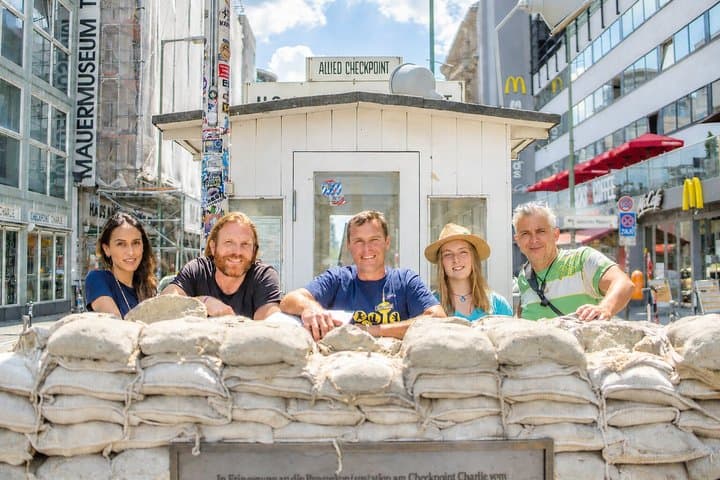
That was the Allied checkpoint. Charly (C), because according to the American alphabet, the other two were in Helmstedt (A for Alpha) and Drei-Linden (B for Bravo). And as an Allied control squad you were allowed to drive through here without being checked by the Soviet occupying power or their East German henchmen. When they wanted to handle things differently in October 1961, shortly after the Wall was built, there was a great threat: 8 tanks each drove up on both sides, a fingerprint away from World War III. Which is why these events would have affected the whole world. So it's not surprising that travelers from all over the world look around here - and don't see much anymore. A replica sentry box from the 50s, the originals from the 80s are in the Allied Museum. A temporary Cold War museum, on a still derelict site. And the privately run Wall Museum, with a collection of curiosities related to escape attempts. (Stop can be omitted if already stop at the wall)
Everyone is talking about Alexanderplatz these days – it would also be strange to talk about Ochsenplatz, even if that was the original name, probably because that's what people traded here. Actually located outside the oldest city walls, it was an eastern extension including St. Mary's Church. The origin of the square can actually be found where the forecourt in front of the Galleria Kaufhof is today. In GDR times, a socialist transformation was wanted here in the sense of a Russian prospectus: with plenty of space for all those marching up, preferably including tanks and other types of weapons, surrounded by modern buildings that somehow stood for the modernity of socialism, from the House of Tourism to over the house of electrical engineering to the house of the teacher. And in the middle of it all, the television tower, still the tallest in Germany today, as proof of socialist engineering and architecture. (May be omitted depending on the length of time.)
The longest surviving piece of the Berlin Wall (1600 m), and actually not a real "front wall" at all. Because the colorfully daubed wall that West Berliners could touch should theoretically have been on the other side of the river. But you could save yourself that here, but there was a hinterland wall, which here resembles the Berlin Wall to the icing on the cake (3.60, high, the sewer pipe ring at the top so that you can't jump up). Originally strictly guarded and snow-white, it was painted with current motifs by 180 artists from all over the world after reunification in 1990: the Trabbi driving through the Wall, the Brezhnev-Honecker kiss. In the meantime renewed several times, the ravages of time are gnawing at this monster of history. (Can be omitted if there is no time left depending on traffic conditions and length of stay at the previous attractions. However, additional time can be booked on site.)
Almost a landmark of Berlin, and if not then at least of the Friedrichshain-Kreuzberg double district, this east-west district that only this bridge connects. Marked by the two medieval towers, it was once the city boundary to the east: the so-called Oberbaum (on the upper reaches of the Spree) swam in the water to prevent ships from passing through at night. Because it was also a customs border, as you can easily see from the coats of arms on the towers: the Brandenburg eagle on the left, the Berlin bear on the right. Today a popular connection on the party mile from Schlesisches Tor to Warschauer Strasse with the RAW (Reichsbahn-Ausbesserungs-Werk) site. There is always something going on. Incidentally, the subway runs on the first floor, hidden behind battlements, then car and bicycle traffic, below shipping. (Can be omitted if there is no time left depending on traffic conditions and length of stay at the previous attractions. However, additional time can be booked on site.)
On both sides you will experience the "confectionery buildings" of the former Stalin-Allee. Renamed after the dictator's death, the so-called workers' palaces were also controversial: after the target increase and wage cuts, the workers moved to the House of Ministries (today the Ministry of Finance) on Wilhelmstrasse. This culminated in the uprising of June 17, 1953, which was brutally crushed by the GDR authorities using Soviet tanks. Today the Stalinist buildings have been renovated and are the longest monument mile in Germany. (Can be omitted if there is no time left depending on traffic conditions and length of stay at the previous attractions. However, additional time can be booked on site.)
Reviews are hosted by Viator
This rating summarises the reviews collected by Viator, which keeps them on its own listing. We show the average exactly as it reaches us, without the individual comments.
Read the reviews on Viator