Berlin Private Complete History All Day Walking Tour
4,9 (500)6hBerlin, Germany
From€210
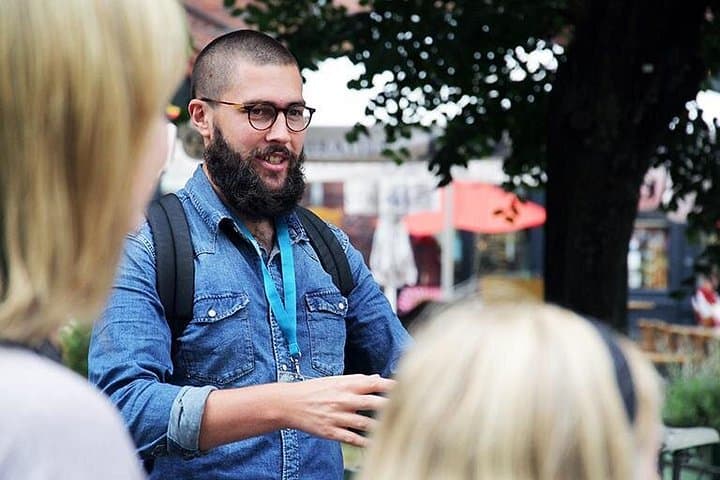
Join a private 3-hour walking tour to explore over 25 illuminated landmarks in Berlin's center. This tour includes sights such as the Brandenburg Gate, Gendarmenmarkt, Bebelplatz, Berlin Cathedral, Museum Island, Nikolaiviertel, and the TV Tower. Participants will learn about Berlin’s history and architecture while enjoying the beauty of its grand boulevards and historic squares at night. The guide will provide insights and assist with photography at key viewpoints. The tour is flexible and adjusts to the seasonal light calendar. During the October Festival of Lights, the focus will be on seasonal illuminations. In winter, festive lights enhance the atmosphere, while the rest of the year highlights Berlin’s classic nighttime appeal. This experience is suitable for couples, families, first-time visitors, and photography enthusiasts. It is important to note that the tour involves walking and may not be ideal for those with mobility issues.
Walk Berlin’s grandest historic boulevard beneath glowing streetlights and rows of monumental buildings. The 1.5-kilometre avenue began not as a royal boulevard but as a simple bridle path in 1573 leading from the palace toward hunting grounds. The first linden trees were planted in 1647, giving the street its name: Unter den Linden literally means “Under the Linden Trees.” Frederick the Great later transformed it into Berlin’s ceremonial showcase, filling it with palaces, cultural institutions and monumental architecture. You’d Never Notice This: what feels like one harmonious boulevard actually contains layers of Prussian monarchy, Nazi-era destruction, East German reconstruction and post-reunification Berlin.
Enter a square often described as one of Berlin’s most beautiful architectural ensembles. Gendarmenmarkt grew out of the late-17th-century Friedrichstadt district and takes its name from the Gens d’armes, a Prussian cavalry regiment once based here. The remarkable symmetry came later: two domed towers frame the Konzerthaus, creating one of Berlin’s most photogenic panoramas. But the “twin cathedrals” hide a wonderful trick: neither domed tower was originally a cathedral at all. Their monumental cupolas were largely decorative statements of royal prestige. The square was devastated during WWII, rebuilt during the East German era and regained its historic name after reunification in 1991. Photo Opportunity: one of the strongest wide-angle nighttime compositions on the entire tour.
Admire one of Karl Friedrich Schinkel’s masterpieces glowing at the centre of Gendarmenmarkt. The building you see today was completed in 1821 after its predecessor burned down. Before that, this site had already been associated with theatre since the 18th century. There is even a Mozart connection: Mozart himself attended a performance here in 1789 during his visit to Berlin. After severe wartime destruction, the building eventually rose again as one of Berlin’s great concert halls. October 2026: the Konzerthaus is included in the official Festival of Lights programme with a façade staging.
Enter one of the most beautiful—and haunting—squares in Berlin. Surrounded by Frederick the Great’s monumental Forum Fridericianum, the square once represented Prussian ambitions in culture, religion and learning. Yet on 10 May 1933, it became the site of one of the most infamous book burnings of Nazi Germany. Around 20,000 books by writers including Thomas Mann, Stefan Zweig, Karl Marx and Erich Kästner were burned here. Remarkable Detail: Kästner himself secretly stood in the crowd and watched his own books go into the flames. During October 2026, several buildings around Bebelplatz are scheduled for artistic illumination, making this one of the richest Festival of Lights clusters on our route.
Stand before one of Europe’s most influential universities. Teaching began here in 1810, built around Wilhelm von Humboldt’s revolutionary idea that university education should unite research and teaching rather than simply transmit existing knowledge. Across its history, 29 Nobel Prize winners have been associated with Humboldt University. Philosophers, physicists, economists and political thinkers who studied or taught here helped shape modern intellectual life far beyond Germany. The main building itself began life as a palace for Frederick the Great’s brother before becoming part of the university. October 2026: its Unter den Linden façade is scheduled for Festival of Lights staging.
Now look down. Hidden beneath a glass panel in the paving lies one of Berlin’s most powerful memorials: Israeli artist Micha Ullman’s sunken library, inaugurated in 1995. Below your feet are stark white shelves—with no books. They contain symbolic space for approximately 20,000 volumes, matching the estimated number burned here on 10 May 1933. You’d Never Notice This: dozens of visitors can cross the square without realizing that one of Berlin’s most moving memorials is literally beneath their feet.
Cross the elegant Schlossbrücke into Berlin’s historic heart. Schinkel transformed what had once been a simple bridge into a ceremonial approach toward the royal palace. Look closely at its sculptural groups: together they depict stages in the idealized life of a classical warrior, turning the bridge itself into an outdoor work of art. From here, evening views open simultaneously toward Berlin Cathedral, Museum Island and the reconstructed palace façades. Photo Opportunity: one of the best transition points between monumental Unter den Linden and the riverfront cityscape.
Few buildings in Berlin contain quite so much political history in one address. For 475 years, this site served as the Berlin residence of the Hohenzollern dynasty. The damaged palace was demolished by the East German government in 1950 and replaced in the 1970s by the socialist Palace of the Republic. That building was itself completely demolished by 2008. The Humboldt Forum followed: its foundation stone was laid in 2013, and the complex began opening in 2020–21. Notice the deliberate architectural contradiction: three reconstructed Baroque palace façades meet one completely modern façade facing the Spree. You’d Never Notice This: you are looking at several erased versions of Berlin occupying essentially the same footprint.
Cross the historic Lustgarten, a space that has repeatedly reinvented itself with Berlin’s politics. In 1573, this area was drained to create a fruit and herb garden beside the palace. Later it became a royal pleasure garden, a military parade ground and eventually a political rally space. One wonderfully eccentric survivor is its enormous granite bowl, weighing approximately 70 tonnes. When it was inaugurated in 1834, around 40 people reportedly sat inside it for breakfast. Berliners nicknamed it the “Berlin soup bowl.”
Leave Berlin’s monumental boulevards behind and step into a maze of small lanes, traditional façades and warm evening lights. This is considered Berlin’s oldest residential quarter, close to where the medieval city developed in the 13th century. But there is a twist: much of what looks centuries old was reconstructed after WWII and redesigned in time for Berlin’s 750th anniversary in 1987. That makes Nikolaiviertel wonderfully Berlin: genuine medieval roots wrapped inside an East German interpretation of historic Berlin. Local Atmosphere: one of the most intimate and photogenic sections of the night walk. October 2026: multiple streets, façades, trees and installations within Nikolaiviertel are included in the official light-festival programme.