Valencia Old Town Tour with Wine & Tapas
5,0 (3710)4hValencia, Spain
From€75
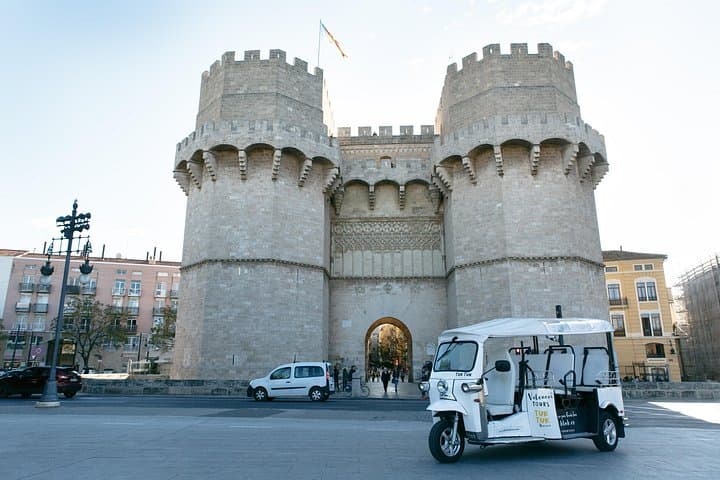
Explore Valencia in a tuk tuk, visiting the city's main tourist destinations comfortably. This experience is suitable for travelers looking for a unique and stress-free way to see the sights. Private tours can be arranged for a more personalized experience, and modifications to the available time slots may be possible upon request. Be aware that this tour is designed for small groups.
The Serrano Towers are a great example of Gothic architecture. They were part of the medieval city walls and were built between 1392 and 1398 by the architect Pere Balaguer. They served as one of the gates of the city with a main defensive function. Because of their location, they were also an entrance for those who came from the Serranos area, hence their name. The towers have two large polygonal towers flanking a central arch. The exterior is strong and simple, reflecting its military purpose. Over the centuries, the towers have served as a defense point, prison for nobles and historical monument. You can explore the interior of the towers and climb to enjoy one of the best views of the city.
Even if it seems ancient, the Sea Gate is a modern reconstruction. It was rebuilt in 1946 to honor the fallen in the Spanish Civil War. It is made of white stone with three arches, the central one being the largest.
Opened in 2002, this bridge was built to offer an extra step over the Turia Gardens. Every four months all the flowers change. That is why it is said to be the most expensive bridge in Valencia. Now is the worst month of the year to see it, as in September the flowers change again and we are in the most expensive months.
Opened in 1923, Mestalla is the home of Valencia CF and one of the most emblematic stadiums in Spain. Designed by architect Santiago Calatrava, the stadium seats 50,000 and is known for its steep stands that bring fans closer to the pitch, creating an exciting atmosphere.
The old port of Valencia occupies a million square meters and is full of activities. It is a center of culture, innovation and business in the city, combining gastronomy, sports, music and entrepreneurship. Veles e Vents, known for its unique architecture, hosts exhibitions, dance events and various arts. the Tinglados and the old shipyard. There are over 800 private moorings for boats, service companies, sports clubs and federations offering sailing, diving and kayaking.
It is the most famous beach in Valencia and has inspired many artists. In the middle of the 19th century it went from being a flower area to the beach we know today. Its wide fine golden sand and easy access to the city make it a popular choice for locals.
This beach gets its name from the old fishing quarter of Valencia. Locals still call it Las Arenas after the old spa, now a luxury hotel complex. His ample The beach has numerous restaurants, entertainment options, Some seaside spots become nightlife spots, with Marina Beach Club
The City of Arts and Sciences of Valencia is a spectacular architectural and cultural complex designed by Santiago Calatrava and Félix Candela. Its construction began in 1996 and ended in 2009, with the aim of revitalizing the city and turning it into a cultural, scientific and leisure center worldwide.
Located in a prestigious area of Valencia, this impressive modernist building was opened in 1928. It was part of a major project to modernize commerce and revitalize the city center. The aim was to create a more modern and functional space for shopping. Designed by architect Francisco Mora, the market features colorful mosaics, ornate columns and a large glass dome. It was renovated in 2003 to become a space with restaurants, cafes and gourmet. It is a symbol of Valencia’s architectural heritage, reflecting its rich history and modernity.
Opened in 1859, the Bullring is one of the most emblematic in Spain and a prominent example of neoclassical architecture in Valencia. Designed by architect Sebastian Monleon, it seats 10,000 and features a circular brick structure with Doric columns, inspired by the Roman Colosseum. In addition to bullfighting, it currently hosts cultural events and concerts, becoming a key cultural reference in Valencia.
Opened in 1917, Estación del Norte is a prominent example of modernist architecture in Spain. It was built to modernize and expand Valencia’s railway infrastructure, creating a more functional and attractive building. Designed by architect Demetrio Ribes, it features colorful ceramics, Valencian-style tiles and ornamental details that reflect the region’s cultural richness. The station has an elegant lobby and waiting area reminiscent of the Harry Potter movies. It is an architectural icon and tourist attraction.
Opened in 1928, the Central Market of Valencia is one of the oldest and most vibrant markets in Spain, with a modernist architecture. It was built to replace the old Market Square and offer a modern and functional space for fresh and local produce, reflecting the growth and modernization of the city. Designed by Francisco Guardia and Alejandro Soler, the market features a large iron and glass dome, colorful ceramics and ornamental details. It remains a key location for fresh produce and is a cultural and tourist landmark, close to other attractions such as La Lonja and Plaza del Ayuntamiento.
The Quart Towers of Valencia are medieval city gates built between 1441 and 1460. They were part of the defensive wall of the city, located on the road to Quart, which connected Valencia with the west and north. Its design is robust and defensive, with two cylindrical towers linked by a wall and a large arch. Made of brick, they have gothic elements and an imposing structure. They were damaged during the War of Independence and restored in the 19th century.
Reviews are hosted by Viator
This rating summarises the reviews collected by Viator, which keeps them on its own listing. We show the average exactly as it reaches us, without the individual comments.
Read the reviews on Viator