Bologna Food Tour: Taste Local Specialties, Pasta, Wine & Gelato
4,9 (1161)3hBologna, Italy
From€84
This self-guided audio tour app allows you to explore Bologna at your own pace. Start at Piazza Maggiore, home to Gothic palaces and the San Petronio facade, alongside the iconic leaning Two Towers. The tour includes a walk through 40 kilometers of UNESCO-protected porticoes, showcasing frescoed ceilings, artisan workshops, and hidden shrines. You can climb the Torre degli Asinelli for panoramic views of the city and visit the world's oldest university, established in 1088. The tour also takes you to the Quadrilatero market district, where local vendors offer traditional foods like mortadella, tortellini, and Parmigiano-Reggiano. This experience suits independent travelers who enjoy exploring at their own pace. It is not ideal for those who prefer guided tours or a structured itinerary.
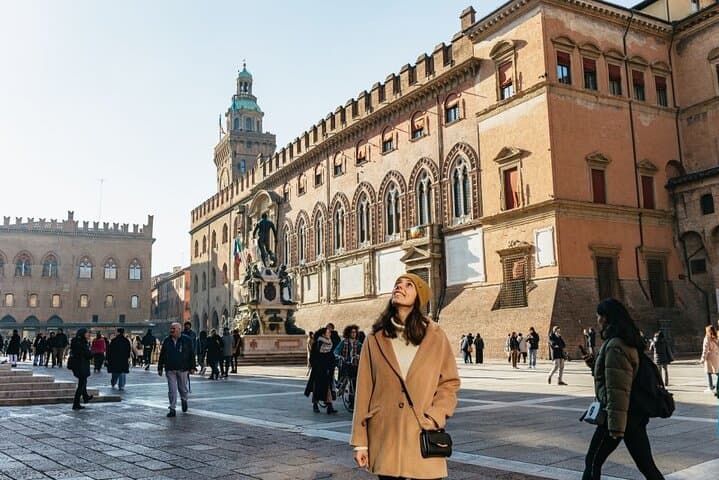
Bologna's magnificent main square has served as the heart of civic life since the 13th century, its harmonious ensemble of medieval and Renaissance buildings creating one of Italy's most impressive urban spaces. The Palazzo d'Accursio (Town Hall), Palazzo del Podestà, Palazzo dei Banchi, and the massive Basilica of San Petronio frame the pedestrianized piazza where students, tourists, and Bolognesi gather at all hours. The square's perfect proportions, absence of traffic, and surrounding cafes make it the natural starting point for exploring a city that rewards aimless wandering through its porticoed streets.
The world's fifth-largest church was intended to surpass St. Peter's in Rome, but papal intervention halted construction, leaving the facade famously unfinished with its lower half clad in pink marble and the upper half in bare brick. The cavernous interior houses a meridian line installed in 1655 that tracks the sun's movement across a 67-meter brass strip embedded in the floor, once used to prove the accuracy of the Gregorian calendar. The 22 side chapels contain important Renaissance artworks while the sheer scale of the nave—132 meters long—demonstrates the ambitions that made Bologna one of medieval Europe's largest and wealthiest cities.
Bologna's iconic leaning towers have defined the city's skyline since the 12th century when noble families competed to build the tallest structures, with the 97-meter Torre degli Asinelli surviving as one of Italy's tallest medieval towers. The shorter Torre Garisenda leans more dramatically at 3.2 degrees (compared to Pisa's 3.97 degrees) and was truncated in the 14th century due to subsidence fears. Climbing the 498 wooden steps of the Asinelli rewards the breathless with spectacular views across terracotta rooftops to the surrounding hills, revealing why Bologna is called 'La Rossa' (The Red One) for its characteristic brick architecture.
The world's oldest university in continuous operation was founded in 1088 and has educated Dante, Petrarch, Copernicus, and countless scholars who shaped Western civilization. The Archiginnasio palace served as the university's main building from 1563 to 1803, its walls and ceilings covered with over 6,000 student coats of arms and inscriptions that create a unique record of academic history. The building houses the magnificent Anatomical Theatre where Renaissance scientists conducted the first systematic dissections, its carved wooden interior representing the dawn of modern medical science.
Bologna's premier art museum houses the definitive collection of Emilian painting from the 14th century through the Baroque, with masterpieces by Giotto, Raphael, and the Carracci family who revolutionized European art from their Bologna academy. The collection's particular strength lies in works by local masters including Vitale da Bologna, Guido Reni, and Guercino, whose dramatic compositions influenced painting across Europe. The museum occupies a former Jesuit novitiate whose spacious galleries allow contemplation of large-scale altarpieces that once adorned Bologna's churches.
Bologna's main north-south thoroughfare showcases the portico architecture that earned UNESCO World Heritage status in 2021, its covered walkways extending nearly 40 kilometers throughout the historic center. The porticoes have sheltered Bolognesi from weather since medieval times when the city required new buildings to include them, creating a unique urban environment where walking remains pleasant regardless of rain or summer heat. Via dell'Indipendenza's arcades connect the train station to Piazza Maggiore, lined with shops, cafes, and the daily flow of citizens who consider the porticoes their extended living room.
This extraordinary complex of interconnected churches, known as 'Sette Chiese' (Seven Churches), preserves Bologna's most ancient religious buildings in a labyrinthine ensemble that transports visitors to the early Christian era. The complex includes a 5th-century baptistery, a Romanesque cloister, and the Church of the Holy Sepulchre modeled on Jerusalem's sacred sites, creating an atmospheric pilgrimage destination within the city walls. Wandering between the weathered stones, ancient columns, and peaceful courtyards reveals layers of construction spanning 1,500 years and offers peaceful respite from the busier streets outside.
This triangular piazza in front of the Santo Stefano complex represents one of Bologna's most atmospheric public spaces, its irregular medieval shape surrounded by noble palaces and the basilica's Romanesque facade. The piazza hosts a popular antiques market on weekend mornings while surrounding cafes provide front-row seats for people-watching in a setting that has changed little since the Renaissance. The combination of ancient architecture, intimate scale, and lively cafe culture makes this square a favorite gathering spot for students and residents who prefer it to the grander Piazza Maggiore.
This vibrant street forms the spine of Bologna's university district, its porticoed length lined with bookshops, student bars, faculty buildings, and the political posters and graffiti that reflect the city's leftist traditions. The Palazzo Poggi houses university museums of natural history, anatomy, and physics whose collections illuminate the scientific achievements of Bologna's scholars. By day, students hurry between lectures while by night, the street's bars and pizzerias fuel the social life of over 80,000 university students whose presence keeps Bologna perpetually young despite its ancient stones.
Bologna's largest and most beloved park spreads across 26 hectares just outside the historic center, its English-style landscaping providing green escape for students, families, and anyone seeking respite from the city's dense urban fabric. The park's lake, playgrounds, and shaded lawns attract picnickers and joggers while the surrounding cafes offer aperitivo with views across the gardens. Created in 1879 and named for Queen Margherita, the park has become essential to Bolognese daily life, offering the breathing room that the porticoed streets, however charming, cannot provide.
Reviews are hosted by Viator
This rating summarises the reviews collected by Viator, which keeps them on its own listing. We show the average exactly as it reaches us, without the individual comments.
Read the reviews on Viator