Valencia Old Town Tour with Wine & Tapas
5,0 (3710)4hValencia, Spain
From€75
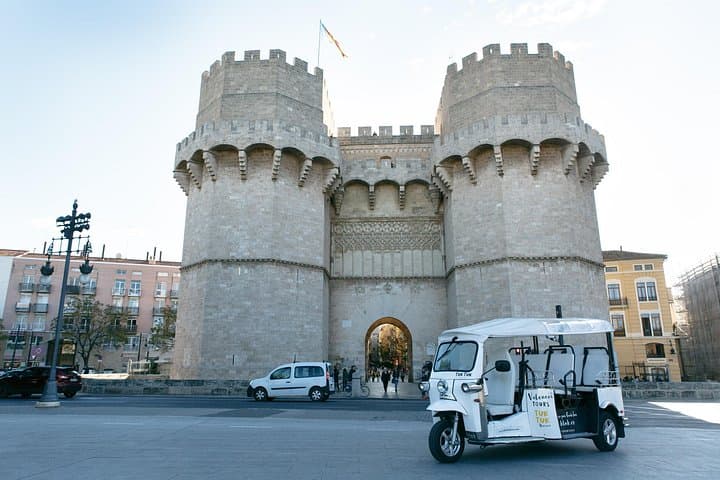
Experience a self-guided walking tour of Valencia over 2-3 hours, using an audio guide on your smartphone. The tour begins at the Railway Station and concludes at the City of Arts and Sciences, with a route that includes the old town. This tour suits those who prefer exploring at their own pace and want to learn about the city without the constraints of a group. It may not be ideal for travelers seeking a guided experience or those without access to a smartphone. The itinerary covers 29 points of interest, including the Cathedral, the Serranos Towers, the Silk Exchange, and the Turia Garden. The audio content, created by professional journalists and historians, is available offline after downloading. It is recommended to use headphones for optimal sound quality.
Ajuntament de València (City Hall) is a grand civic building overlooking Plaza del Ayuntamiento. Built in the early 20th century, it blends neoclassical and baroque elements with a richly decorated façade and central clock tower. Inside are elegant halls and balconies — especially lively during festivals when officials watch celebrations from above. It’s the administrative heart of the city, both formal and festive.
Palacio del Marqués de Dos Aguas is Valencia’s most extravagant building — a baroque fantasy wrapped around a noble palace. Its entrance is a swirling marble masterpiece, like stone melting into sculpture. Inside, it houses the National Ceramics Museum, with opulent rooms, gilded ceilings, and delicate porcelain. Dramatic, ornate, and impossible to ignore.
Plaza Redonda is a unique circular square tucked into Valencia’s old town. Surrounded by curved façades and small shops, it feels almost hidden — like stepping into a quiet courtyard. Once a market space, today it’s known for souvenirs, lace, and a peaceful break from the busy streets.
La Lonja de la Seda is Valencia’s most impressive Gothic building — a former silk exchange from the 15th century and a UNESCO World Heritage site. Inside, the Hall of Columns rises like a stone forest, symbolizing the city’s wealth and power during its trading peak. Elegant, austere, and deeply symbolic — it’s medieval commerce turned into architecture.
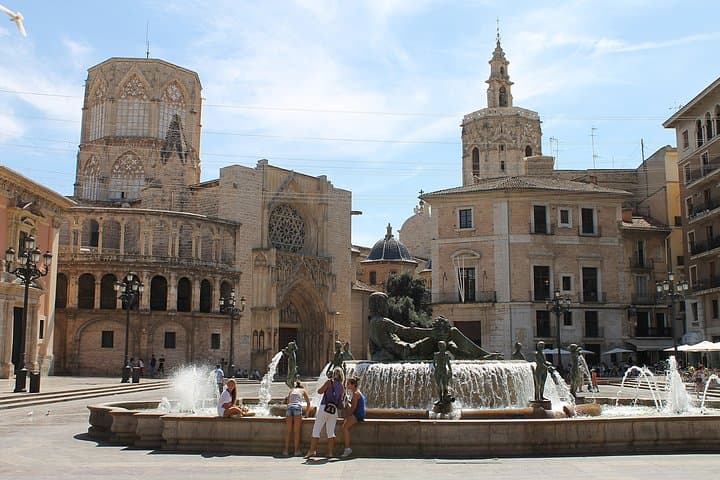
Catedral de Valencia is a blend of styles — Romanesque, Gothic, and Baroque — reflecting centuries of change. Inside, it houses what many believe to be the Holy Grail, kept in a small chapel. Climb the Miguelete Tower for panoramic views over the city. Historic, layered, and full of quiet surprises.
Tribunal de las Aguas is one of Europe’s oldest living institutions, meeting every Thursday at noon outside Valencia Cathedral. Dating back over 1,000 years, it settles disputes over irrigation water among local farmers — quickly, orally, and in public. No paperwork, no delays — just tradition in action. Simple, ancient, and still respected today.
Basílica de la Virgen de los Desamparados is one of Valencia’s most beloved religious sites, dedicated to the city’s patron saint. Located on Plaza de la Virgen, its baroque interior glows with frescoes and devotion. Locals come here not just to admire, but to pray — especially during festivals. Intimate, emotional, and deeply tied to Valencia’s identity.
Museo de Soldaditos de Plomo (L’Iber Museum) is a unique collection of miniature soldiers housed in a historic palace in Valencia. With over 90,000 figures, it recreates battles and scenes from history in incredible detail. Small scale, big imagination — it’s like walking through history in miniature.
Jardín del Turia is Valencia’s green lifeline — a vast park stretching through the city along the former riverbed of the Turia. After the river was diverted, it became a ribbon of gardens, paths, playgrounds, and sports areas. Locals run, cycle, picnic, and relax here daily. It’s not just a park — it’s the city breathing.
Puente de las Flores is one of Valencia’s most colorful bridges, crossing the Turia Gardens. True to its name, it’s lined with thousands of seasonal flowers that change throughout the year, creating a bright, living ribbon over the park. Simple structure, striking effect — it’s all about the color.
Parque Gulliver is one of Valencia’s most playful spots — a giant playground shaped like Gulliver from Gulliver’s Travels. His body becomes slides, stairs, and climbing paths, turning kids into “tiny Lilliputians.” Located in the Turia Gardens, it’s fun, surreal, and surprisingly creative — even adults can’t resist a climb.
Ciudad de las Artes y las Ciencias is Valencia’s futuristic showpiece — a vast complex of white, sculptural buildings designed by Santiago Calatrava. It includes a science museum, planetarium, opera house, and Europe’s largest aquarium. Set among water pools and open spaces, it feels more like a vision of the future than a city district. Bold, modern, and unforgettable.
Museo de las Ciencias Príncipe Felipe is Valencia’s hands-on science museum, shaped like a giant futuristic skeleton. Inside, everything is about interaction — touch, experiment, explore. From physics to space, it turns science into something playful and accessible. Big, bright, and built for curiosity.
Oceanogràfic is Europe’s largest aquarium, located in Valencia’s City of Arts and Sciences. It showcases marine life from oceans around the world—sharks, dolphins, penguins, and more — spread across themed habitats. The highlight is the underwater tunnel, where you walk surrounded by sea life. Immersive, modern, and unforgettable.
Reviews are hosted by Viator
This rating summarises the reviews collected by Viator, which keeps them on its own listing. We show the average exactly as it reaches us, without the individual comments.
Read the reviews on Viator