Valencia Old Town Tour with Wine & Tapas
5,0 (3710)4hValencia, Spain
From€75
Participants will explore Valencia on personalized electric bike routes tailored to their interests and skill levels. This experience is suitable for individuals or small groups looking for a unique and engaging way to see the city. It is not ideal for large groups or those who prefer traditional sightseeing methods. Each tour is led by local guides who share insights and stories about the area. The bicycles are advanced models that provide smooth riding and enhanced security. The tour emphasizes ecotourism and sustainable practices to minimize environmental impact. Support is available before, during, and after the ride to ensure a satisfactory experience.
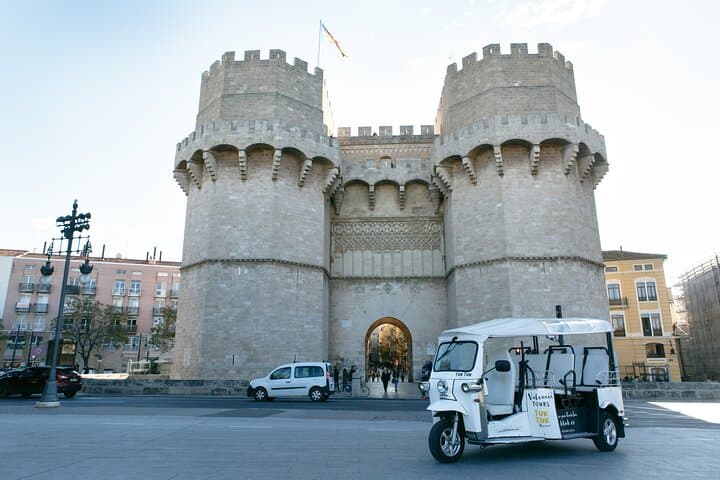
The Serranos Towers or Serranos Gate are one of the two fortified gates of the medieval wall of Valencia (Spain) that still remain standing.
Popularly known as La Peineta for its unique shape, the bridge was designed by the famous Spanish architect Santiago Calatrava.
The Palau de la Música de Valencia or Palacio de la Música y Congresos de Valencia is an auditorium in the city of Valencia located in the old bed of the Turia River. It will surprise you!
The Bridge of Flowers, officially and in Valencian, pont de les Flors, separates sections IX and X of the Turia Garden, in the city of Valencia. It was inaugurated in 2002 and was designed by engineer Manuel Biedma.
The City of Arts and Sciences is an impressive architectural, cultural and entertainment complex in the city of Valencia. The complex, in a neo-futurist style, was designed by Santiago Calatrava and Félix Candela. It was inaugurated on June 9, 1998 with the opening of El Hemisférico. Currently the essential place to visit if you travel to Valencia.
The Turia Garden is an urban public park located in the old bed of the Turia River in the city of Valencia. Currently it is the green lung of the city. It is the largest green place in Valencia. Place where sports, bike rides, playgrounds are practiced...or you can miss it!
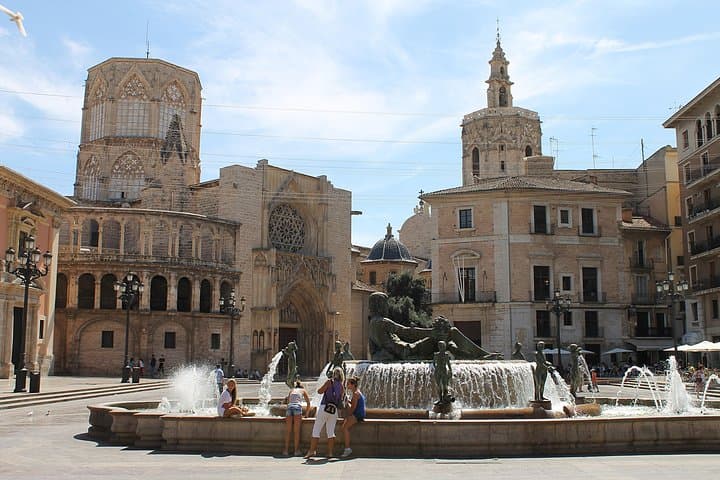
Valencian Gothic is the predominant construction style of this cathedral, although it also contains elements of Romanesque, French Gothic, Renaissance, Baroque and Neoclassical. Inside, the Holy Chalice is venerated, dating from the 1st century, and given to the cathedral by King Alfonso the Magnanimous in 1437.
The royal basilica of the Virgen de los Desamparados is located in the city of Valencia. It stands out for being the sanctuary of the Virgen de los Desamparados, Patroness of Valencia and the entire Old Kingdom of Valencia,12 current Valencian Community.