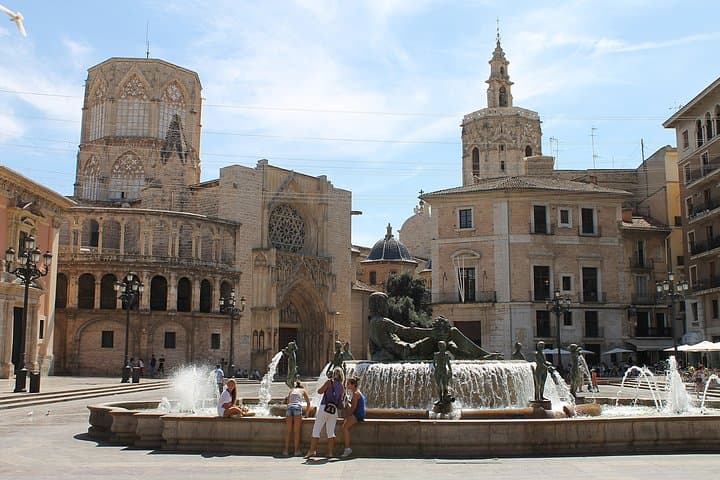
Valencia Old Town Tour with Wine & Tapas
5,0 (3710)4hValencia, Spain
From€75
This 120-minute tuk tuk tour of Valencia takes you through the city center, including major historical and cultural sites, the City of Arts and Sciences, the harbor, marina, and beach. You have the option to stop at any moment for photos. This tour is suitable for those looking for a fun and comfortable way to explore the city. It may not be ideal for travelers preferring to explore on foot or at a slower pace.
Is the main railway station in Valencia. The building is one of the main works of the Valencian Art Nouveau and was declared Good of Cultural Heritage in 1987.
The Torres de Quart are one of the two fortified gates of the medieval wall of Valencia that still remain standing.
Modern art museum
The Torres de Serranos are one of the two fortified gates of the medieval wall of Valencia (Spain) that still remain standing. It has been an Asset of Cultural Interest since 1931.
Museum of Fine Arts of Valencia (in Valencian, Museu de Belles Arts de València) is a state-owned museum, managed by the Generalitat Valenciana. Due to the importance of its collections, it is one of the first painting museums in Spain, being a clear reference in terms of old Valencian masters.
The Palau de la Música de Valencia is an auditorium of the city of Valencia located in the old course of the Turia river. Inaugurated in 1987, it contains several rooms for musical auditions, conferences, exhibitions, shows and film screenings, among other activities.
Marina Real and port of the city of Valencia
One of the main urban beaches of Valencia
The City of Arts and Sciences is an architectural, cultural and entertainment complex of the city of Valencia. The complex was designed by Santiago Calatrava and Félix Candela, together with the engineers who created the structural design of the roofs of the Oceanografic Alberto Domingo and Carlos Lázaro.
The building was conceived and carried out by the architect Francisco Mora Berenguer between the years 1914 and 1916. It is one of the best examples of the architecture of Valencian Modernism from the beginning of the century.
This palace is the main example of Rococo in Valencia. The González Martí National Museum of Ceramics is housed inside, and its alabaster marble façade is the work of Ignacio de Vergara.
The bull ring of the cit of Valencia. It is neoclassical, specifically simple Doric, inspired by Roman civil architecture, the Flavian amphitheater, or the Nimes amphitheater.
Reviews are hosted by Viator
This rating summarises the reviews collected by Viator, which keeps them on its own listing. We show the average exactly as it reaches us, without the individual comments.
Read the reviews on Viator